
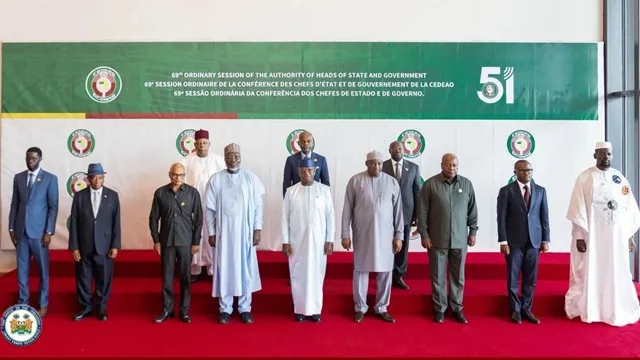
ECOWAS Endorses $25B Mega Pipeline Project from Nigeria to Morocco
On 19 July 2026, the Economic Community of West African States (ECOWAS) endorsed the Nigeria-Morocco Atlantic Africa Gas Pipeline (AAGP) Project. The pipeline is about 6,800 kilometers long and traverses 13 countries.
It is designed to facilitate the transport of up to 30 billion cubic meters of gas, with half of the volume destined for the European Union. African countries along the way may also tap into the resource to enhance their #EnergySecurity. Compared to oil, natural gas also has the advantage of a small carbon footprint.
“This pipeline aims to link the gas resources of West Africa to the principal consuming markets in the regions, while laying the foundation for an integrated regional energy market and creating a new corridor of development, linking West Africa, Sahel States, Morocco and Europe.”
Extract from ECOWAS Communique
In 2016, Morocco’s King Mohammed VI and Nigeria’s former President Muhammadu Buhari jointly initiated the mega Project. Now, Nigeria’s current President Bola Tinbu still supports it. Both leaders have designated their respective organizations to follow through with the implementation, namely, Morocco’s National Office for Hydrocarbons and Mines, and the Nigerian National Petroleum Company (NNPC).
In addition, the Project Management Office will be based in Casablanca in Morocco, while the Pipeline Management Authority will be based in Abuja in Nigeria.
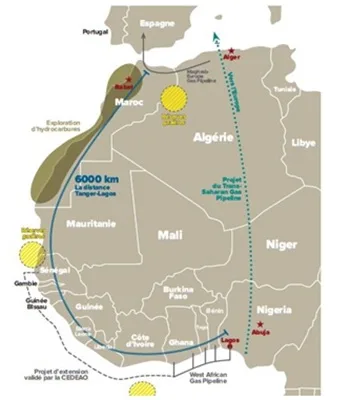
According to the communique, construction is expected to kick off in 2028, and the first gas delivery is projected for 2031. The Project has been fast-tracked due to the protracted Ukraine-Russia conflict, as the EU seeks to diversify its energy sources away from Russia.
On the other hand, Algeria has been promoting the Trans-Saharan Gas Pipeline (TSGP), which basically performs the same function. On 4 June 2026, Algerian firm Sonatrach officially broke ground on the 4,128-kilometer pipeline.