
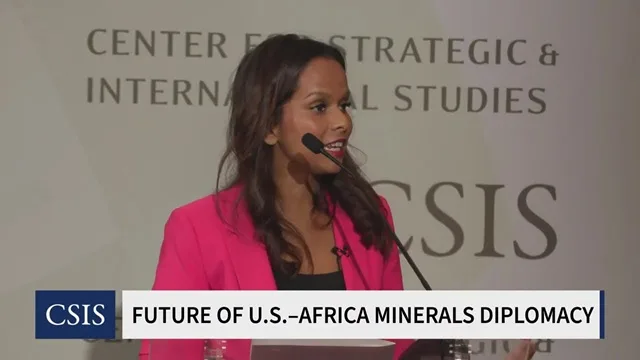
CSIS High-Level Forum as Harbinger for New Era in US-Africa Minerals Partnership
Timely Forum
On 18 September 2026, Gracelin Baskaran, Director of the Critical Minerals Security Program at the Center for Strategic and International Studies (CSIS) hosted a high-level forum around ‘The Future of US-Africa Minerals Diplomacy’ in Washington, DC, USA. The event is a follow up to the Critical Minerals Ministerial organized by the US Department of State in February 2026.
Interestingly, this Forum also took place just after China’s International Mining Conference 2026 in Tianjin and just before the proposed visit of China’s President Xi Jinping to the USA. In the context of the trade war between the US and China, China has largely managed to counteract the USA thanks to its dominance on #RareEarths.
Growing Appetite for Critical Minerals
The Forum attracted unusually senior participation, reflecting the huge appetite for #CriticalMinerals. Among the US high officials, there were: US Secretary of Energy Chris Wright, Assistant Secretary of State for African Affairs Frank Garcia, and EXIM Chairman John Jovanovic. Africa was represented by Guinea’s Minister of Mines Bouna Sylla and several ambassadors based in DC.
Several senior executives from US companies also attended, including Alcoa, Glencore, KoBold, Lifezone. Other than #USEXIM, senior officials from DFC and the Department of Commerce also participated.
Guinea Bauxite
Boke Investment Company has a majority stake of 51% in the Compagnie des Bauxite de Guinee, which owns and operates the Sangaredi bauxite mine in the Boke region in northwestern Guinea. In turn, Boke Investment Company is wholly owned by Halco Mining, in which Alcoa has a 45% shareholding, along with other partners, notably mining major, Rio Tinto.
Guinea boasts the largest reserves of bauxite the world, estimated at about 7.4 billion tonnes, well ahead of the Australia’s second largest at 3.5 billion tonnes. Miinster Sylla reiterated the Government of Guinea’s plicy to promote local value addition (#LVA). Specifically, Guinea targets five to six alumina smelters to produce at least 7 million tonnes of alumina locally by 2030.
On the other hand, the US wants to secure a supply of bauxite to make aluminum. Thus, Alcoa CEO Bill Polinger and Guinea’s Minister of Mines Sylla explored ways to achieve a win-win partnership. It is worth noting that nearly 75% of Guinea’s bauxite is currently exported to China.
DRC Cobalt
The Democratic Republic of Congo (DRC) holds the largest reserves of cobalt in the world, with an estimated 6 million tonnes, far ahead of second place Australia with 1.7 million tonnes.
Thus, Orion and Glencore are in talks to secure cobalt for the US market. Glencore owns the Kamoto Copper Company and Mutanda Mining which are major producers of copper-cobalt in the DR Congo. DFC and Abu Dhabi ADQ have agreed in principle to back the deal financially.
Zambia Copper
Zambia is world-famous for its #Copperbelt region that is rich in copper. KoBold has acquired an 80% stake in Mingomba Mining in a bid to guarantee copper supply to the USA, which is in the midst of an #AI data center construction boom, requiring large quantities of copper wiring.
Interestingly, KoBold is adopting the latest AI technology to update geological maps, carry out geophysical surveys, and process seismic data. #Hitech is in the DNA of KoBold as its early investors invlude Bill Gates of Microsoft fame and Jezz Bezos of Amazon.
Securing Supply Chain
The Forum underscored Africa’s unique position as being the irreplaceable source of several Critical Minerals. It highlighted the challenges that US companies have to overcome as they race to catch up with China on the continent. The #LobitoCorridor is the flagship regional initiative to facilitate access to the Copperbelt in Zambia and the DRC.
The US believes that it can leverage its advantages in capital mobilization, technology leadership, and higher norms to carve out a piece of the pie in Africa. To cooperate with African countries to move up the mineral value chain, investments in extraction will have to go hand in hand with investments in power generation to allow local refining.