South Africa Seeks $3B Partnership to Upgrade Manganese Corridor
On 23 September 2026, Transnet officially issued a Request for Qualifications (RFQ) for the Ngqura Manganese Export Corridor (NMEC) with media release rolling out through 25 September 2026.
South Africa holds roughly 70% of the world’s known reserves of #manganese, and the Manganese Corridor carries nearly 40% of global manganese export tonnage and 65% of global export value. However, the logistics of manganese is experiencing severe bottlenecks, forcing costs up and stretching out delays.
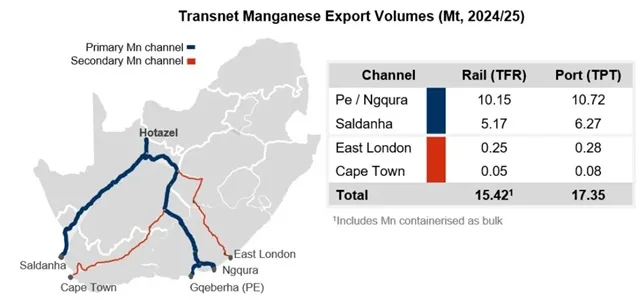
Currently, Transnet moves about 12 million tonnes annually via rail. Due to unmet demand, another 10 million tonnes has to be hauled by trucks to satisfy the world’s appetite for manganese. The main backbone of Manganese Corridor runs from Hotazel to the seaport of Ngqura and measures about 1,100 kilometers in length.
Therefore, the Government of South Africa plans to upgrade and favor the rail modality in a bid to reduce delays, costs and emissions. The objective is to upgrade the freight capacity of the rail to at least 16 million tonnes annually, and gradually phase out heavy-hauling on roads. South Africa is contemplating a Public-Private Partnership (#PPP) with a concession term of 25 years.
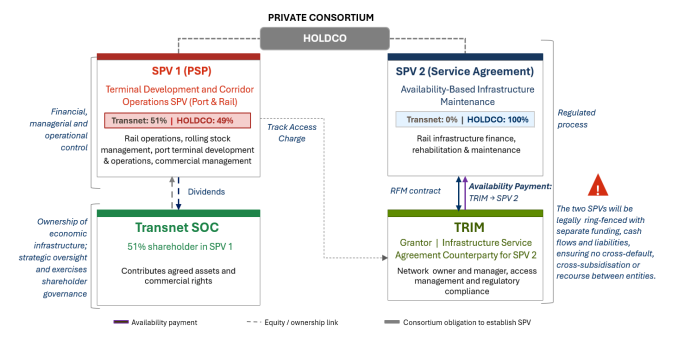
It is estimated that the project would require an investment of ZAR 44 billion ($2.7B). To realize the project, South Africa has come up with a cooperation framework involving a dual Special Purpose Vehicle (SPV) model . The first SPV would handle the terminal and freight operations, while the second #SPV would be responsible for upgrading and maintaining the rail infrastructure. The model would thus separate infrastructure from operation.
Transnet would retain a 51% in the high-margin operational SPV, while the selected partner will be solely responsible in investing in modernizing the rail. It is estimated that the rail upgrade component would require an investment of about ZAR 20 billion ($1.2B).
Interested parties have until 26 February 2027 to submit their applications. Then, Transnet will invite Request for Proposals (RFP) from shortlisted companies around mid-2027.