
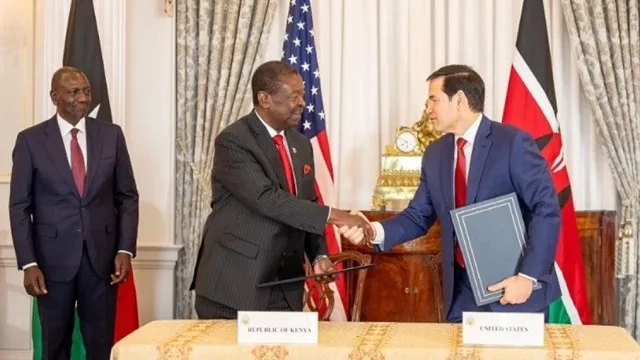
USA and Kenya Seal Landmark $2.5B Five-Year Health Partnership
On 4 December 2025 in DC, US State Secretary Marco Rubio and Kenyan Prime Cabinet Secretary Musalia Mudavadi signed a Health Cooperation Framework worth USD 2.5 billion over a period of five years from 2026 to 2030. The signing took place with Kenyan President William Ruto as witness, as he led a delegation to Washington, DC, where he also attended the Signing Ceremony for the Peace Deal between DR Congo and Rwanda.
Under the Framework, the US will provide up to USD 1.6 billion to support priority health programs in Kenya, including HIV/AIDS, tuberculosis, malaria, maternal and child health, polio eradication, disease surveillance, and infectious disease outbreak response and preparedness. At the same time, Kenya will provide USD 850 million to the program. The US will gradually reduce its financing annually during the course of the program, while Kenya will ramp up its financing. The idea is that Kenya shall be able to assume greater responsibility for its health system and it builds capacity in partnership with the USA.
“We are delighted to sign this landmark agreement with Kenya, a longstanding American ally. As Secretary Rubio has emphasized, foreign assistance is a tool of American diplomacy and statecraft—and every dollar we spend on it must be directly justified on those terms. When developing the dozens of America First Global Health Strategy (#GHS) bilateral agreements we will sign in the coming weeks, we always start with the principle that American sovereign resources should be used to bolster our allies and should never benefit groups unfriendly to the United States and our national interests.”
US State Under Secretary Jeremy Lewin
The Framework includes a number of innovative clauses, such as:
- The procurement of medical supplies will be transitioned from US Government to the Kenyan Government
- Frontline health workers paid by the US will be mapped as cadres in the local health system and gradually come under the Kenyan Government’s payroll
- The US will implement and scale up the Kenyan #eHealth gsystem which will allow for electronic medical records
- The Kenyan Government, with support from the US Government, will provide reimbursement mechanisms to faith-based and private sector health service providers
“The Kenyan government is already expanding essential health services to all Kenyans and increasing domestic health financing through the Social Health Authority (SHA). Kenyan and United States’ commitments in the Framework are thus fully aligned and mutually beneficial.”
Kenya President William Ruto
Certain NGO were not too happy about losing funding from the US Government and raised concerns about data privacy and patient privacy resulting from the #digitalization of the health system. President Ruto reassured Kenyans that he is acting in their best interest by upgrading the health system. The Kenyan Health Minister Aden Duale gave assurances that the data will be aggregated and depersonalized in support of policy-making.
The negotiations took place over several months and was led on the Kenyan side by Aden Duale, Kenya’s Cabinet Secretary for Health. The partnership is based on co-investment and is a departure since it is a #G2G agreement, whereas previously it was mostly aid channelled via NGO. Brade Simith, Senior Advisor for the Bureau of Global Health Security and Diplomacy at the Department of State, believes this is a landmark agreement which will serve as a template for other similar agreements.