
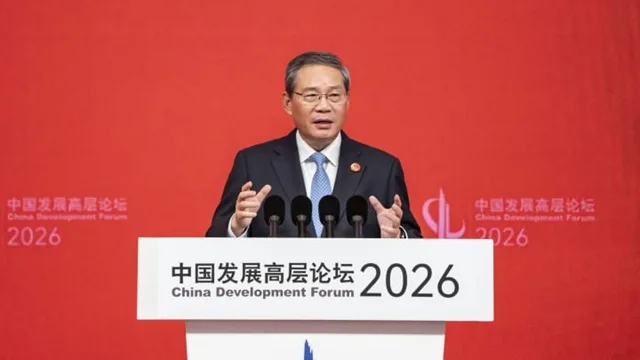
Premier Li Promises More Openness and Better Trade Balance at China Development Forum 2026
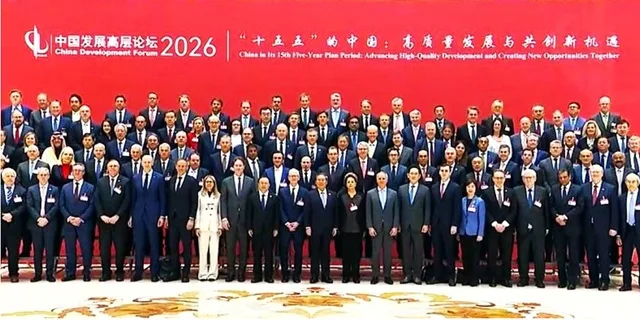
The 2026 edition of the annual China Development Forum opened in Diaoyutai State Guesthouse in Beijing on 22 March 2026. The theme for this edition is: “China in its 15th Five-Year Plan: Advancing High-Quality Development and Creating New Opportunities Together.” China’s Premier LI Qiang delivered the welcome keynote address to a full house of foreign guests handpicked from the Fortune 500.
During his speech, Premier Li promised to rebalance trade with other countries and to open the Chinese market more to foreign investors, following criticism from around the world. As an example of the new attitude, China will enact a zero-tariff policy for all African countries as of the 1st of May, 2026. Additionally, during the recent #TwoSessions2026, China decided to open up the medical sector to foreign investment.
On the other hand, Apple CEO Tim Cook reiterated that China remains central to his company’s strategy, despite geopolitical tensions forcing delocalization to other geographies to mitigate supply chain risks. In 2018, just before the #COVID, Apple produce 90% of Apple’s phones just a few years ago; in 2025, India produced 25% of Apple’s phones. Apple’s move is representative of other multinationals that are derisking, but not decoupling from China.
He reiterated China’s willingness to purchase advanced equipment, but countries are wary about supplying China with their latest technologies, fearing being copied and undercut in the future. Examples abound from tomato sauce to electric vehicles,
The huge USD 1.2 trillion in trade surplus is becoming the cause of much trade tension, and has resulted in the raising of tariffs from certain countries, most notably the USA.
China appears to be doing quite well despite tariffs imposed by the US. On the other hand, Foreign Direct Investments (FDI) fell by nearly 6% year-on-year to just USD 13.4 billion (Y92B) in 2025. Chinese Commerce Minister WANG Wentao reassured investors by ensuring policy stability and improving intellectual property (#IP) protection.
The risks brought about by the Middle East conflict, coupled with a sustained rivalry between China and the USA, contributed to a lackluster economic performance. China presented itself as a sizeable, stable, predictable economy. However, many businesspeople appear to be more comfortable sitting on the fence rather than rushing to commit to the Chinese market.