

Zimar Seals Deal for $2B Dosso Oil Refinery in Niger
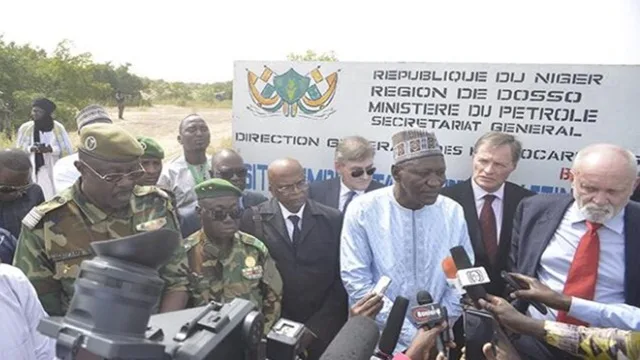
On 15 August 2026 at the Prime Minister’s Office in Niamey, Zimar Group sealed a deal with the Government of Niger to build a USD 1.9 billion oil refinery. Minister of Foreign Affairs Bakary Sangare led the negotiation team representing the interests of Niger and signed on behalf of the Government. Zimar CEO Benjamin Marc represented both Zimar and its American partner High Tech to sign the deal. This Agreement follows the Memorandum of Understanding signed in 2024.
According to the Agreement, the Refinery Project is cast as a Public-Private Partnership (PPPP) and will be implemented under a Build-Operate-Transfer (BOT) model. The term of the Agreement is 16 years, whereby construction will last 3 years and operation will continue for 13 years.
The Government of Niger will not hold any equity during the initial 16-year period, but at the end of the term, full 1000% ownership will be transferred to the Government of Niger at no cost. Additionally, the Government of Niger will guarantee the crude oil feedstock from Niger’s oil fields, such as Agadam, to the refinery.
This deal differs from the Zinder Refinery with China National Petroleum Corporation (CNPC), which is structured as a Production Sharing Agreement (PSA). In the Zinder Refinery, the Government of Niger holds a 40% equity, but the capacity is smaller at 20,000 barrels per day (bpd).
It is reported that the Government of Niger experienced friction with CNPC by enforcing local content rules. Thus, the introduction of a new player shall allow competition to come into play, and provide more leverage to Niger.
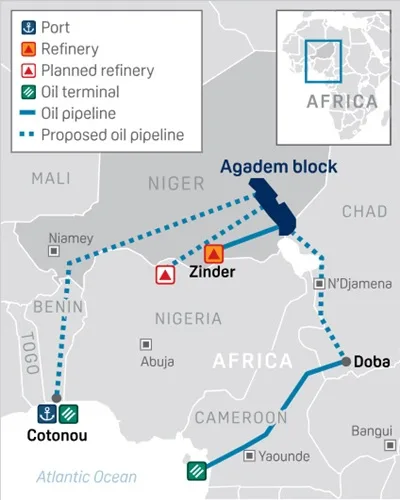
Niger’s economy is rather small and can consume at most 7,000 bpd. After satisfying the domestic market, Niger plans to export to neighboring countries such as Burkina Faso, Mali and Benin.
Niger has an estimated reserve of 3 billion barrels of crude oil. The Dosso Refinery will have a capacity of 100,000 barrels per day and will rank as the 3rd largest refinery in West Africa, behind Nigeria’s Lekki Refinery (700 kbpd) in Nigeria and Ghana’s Sentuo Refinery (120 kbpd). Recently, the Niger-Benin pipeline was also launched.
The Consortium has 4 months to mobilize the financing and finalize the detailed engineering design. Final Investment Decision and groundbreaking is expected within a year. The need for a refinery became pressing as upstream production has exceeded 100,000 bpd, much more than Niger’s local needs. Rather than exporting crude oil, Niger naturally wishes to extract and retain as much value locally.