
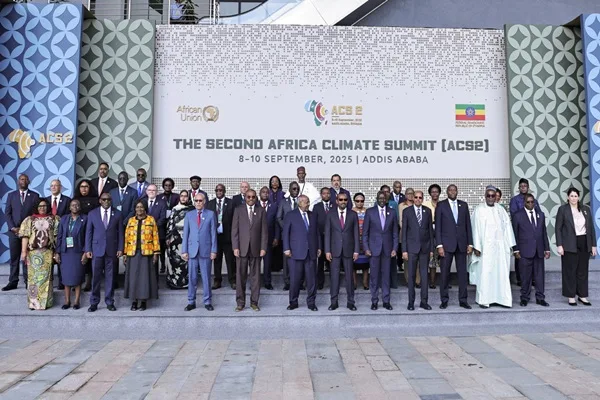
2nd African Climate Summit 2025 Calls for More Down-to-Earth Actions
The 2nd Africa Climate Summit (#ACS2025) kicked off in Addis Ababa on 8 September 2025. The Summit is organized by the African Union (AU) and the Government of Ethiopia which is the host.
The Summit follows right after the African Climate Week organized by the United Nations Framework Convention on Climate Change (UNFCCC) and the Government of Ethiopia and took place from 1 to 6 September 2025. On 9 September 2025, Ethiopia also plans a grand ceremony for the commissioning of the Grand Ethiopian Renaissance Dam (#GERD), the largest Hydropower Plant (#HPP) in Africa with an installed capacity of 5 GW.

Convened under the theme “Accelerating Global Climate Solutions: Financing for Africa’s Resilient and Green Development”, the Summit attracted more than 25,000 delegates, leaders from AU and UN, heads of state or government, ministers, private sector stakeholders, civil society, young leaders, and development partners.
Under the Green Legacy Initiative launched in 2019, Ethiopia has planted more than 48 million trees to cool the land and protect the soil. Through Yelemat Tirufat, or Bounty of the Basket, Ethiopia is reshaping food systems by cutting import invoices, while growing farming incomes.
“Too often, Africa’s story at climate summits begins with what we lack: lack of finance, lack of technology, lack of time. Let us begin instead with what we have: the youngest population in the world, bursting with creativity and innovation; the fastest-growing solar belt on Earth; the planet’s last carbon vaults, in our forests, wetlands, and coasts; vast arable land that can feed a growing continent and beyond; rich deposits of #CriticalMinerals for green technologies, renewable energy from sun, wind, and geothermal; and a tradition of resilience and innovation built over millennia.”
Ethiopia PM Abiy Ali
The inaugural edition was hosted by Kenya and took place in Nairobi in 2023. At the end of 2025, Brazil will host the #COP30 in Rio. Therefore, the ACS serves to harmonize African action in order to speak with one voice as Africa fights for more climate justice. PM Ali proposed the launching of an African Climate Innovation Compact and ask international partners not to fund Africa to mitigate the climate crisis, but to invest in climate solutions because Africa has the potential and vision.
Two years ago, the Nairobi Declaration was centered around beautiful promises around renewable energy, resilient agriculture and green financing, which unfortunately remained largely theoretical due to lack of commitment from international development partners.
In particular, the lack of commitment from certain international stakeholders had put a damper on the development of the carbon market which was supposed to be a source of innovative finance for climate action. Therefore, it is hoped that the Addis Declaration will be more result-oriented.