
COP30 in Brazil Shines Spotlight on Amazon Forest Carbon Sink
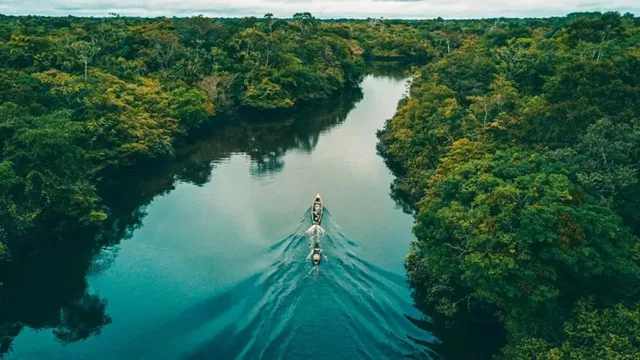
The COP30 is taking place in Belem in Brazil from 10 to 21 November 2025. It will be an opportunity to shine the spotlight on the Amazon Forest as one of the world’s largest carbon sinks which contributes to regulating the global climate. Actually, the venue for #COP30 is the city of Belem that lies right one the edge of the Amazon Forest, and is sometimes referred to as the Gateway to the Amazon.
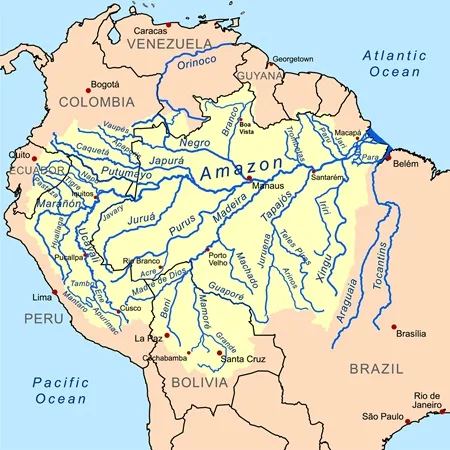
The area of the #AmazonForest is 7 to 8 million square kilometers (km2), depending on how forested areas are defined and classified. Generally speaking, the dense rainforest area is estimated to be about 5.5 million km2. The Amazon Forest covers nine South American countries: Brazil, Bolivia, Colombia, Ecuador, French Guyana, Guyana, Peru, Suriname, Venezuela, with 60% of the Amazon Forest inside Brazil.
The Amazon Forest is irrigated by the Amazon river network which has an extensive tributary system that extends almost coast-to-coast from Brazil on the Atlantic Ocean to Peru on the Pacific Ocean. The Amazon River is the longest river in the world with a total length of 6,575 kilometers.
The Amazon Forest stores about 200 billion tonnes of carbon in its trees, vegetation, and soil, representing about 20 years of global CO2 emissions at today’s emissions rate. Annually, the Amazon captures about 2 billion tonnes of CO2 (#tCO2) via photosynthesis and accounts for up to 10% of global carbon fixation.
Due to deforestation, logging, and fires, some parts of the #Amazon are now net carbon emitters. Studies have shown that the Amazon has lost some 30% of its carbon capture capacity over the last two decades. Fires in the Amazon Forest release hundreds of millions tC02 in the atmosphere annually. If degradation is not brought under control, the forest can turn into a savannah and permanently become a carbon emitter.
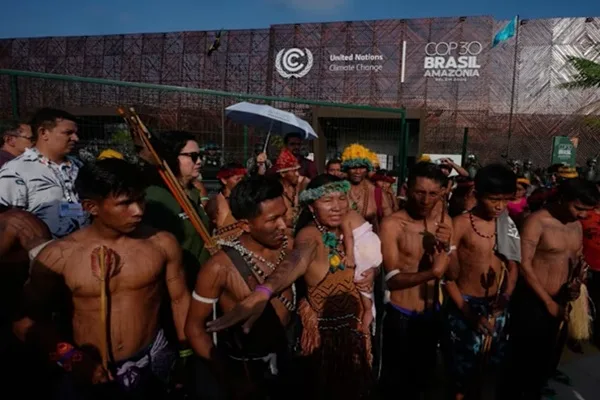
Brazilian President Lula is pushing its Tropical Forests Forever (#TFF) initiative in a bid to secure funding for the preservation of the Amazon Forest. At the same time, Amazonian tribes have called for greater say in determining the fate of their home. Every year, it is estimated that the world is spared hundreds of millions of dollars of climate damage thanks to the Amazon’s role in carbon fixation and climate stabilization.
The other large forests in the world include the Boreal Forest #Biome, spanning Scandinavia, Russia, Canada and Alaska, with a total area of 12 million km2 and the #CongoBasin on the African Continent with an area of about 2 million km2. At #COP30, some climate advocates are also lobbying to preserve large seagrass areas which are also significant carbon sinks.