
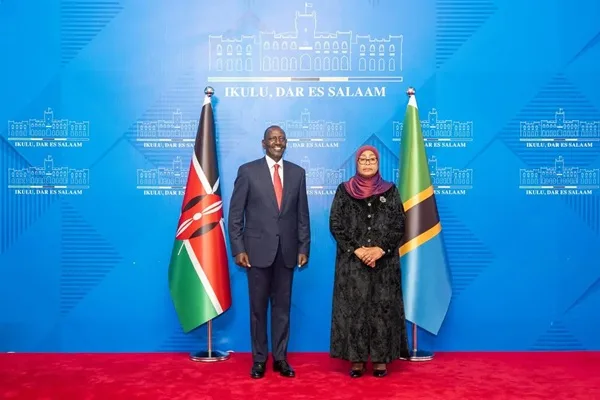
Kenya and Tanzania Push Forth On Regional Integration, But Pull Back Over Regional Oil Refinery
From 4 to 5 May 2026, Kenyan President William Ruto was on a state visit to Tanzania. During the visit, the two countries signed several agreements in a bid to boost trade and investment, while strengthening cooperation between the two East African neighbors.
Speaking before the Tanzanian Parliament, Ruto noted that bilateral trade between Kenya and Tanzania reached USD 860 million in 2025. For 2026, the trade volume is expected to exceed USD one billion in 2026, representing more that 15% increase. In order to achieve this target, both sides are committed to removing Non-Tariff Barriers (#NTB) and reducing regional logistical costs via enhancing regional #connectivity. Actually, the roadmap is to eventually boost trade within the East African Community (EAC).
“Intra-regional trade within the EAC remains low, at between 10% and 15% of total trade, which means that the majority of our commerce still takes place outside the region. This gap represents a major opportunity for expansion.”
Kenya President William Ruto
On the investment front, Kenyan firms have committed USD 1.7 billion of investments in Tanzania. The foreign direct investments (#FDI) cover several strategic sectors, including manufacturing, logistics, energy, agriculture and financial services. On the other hand, Tanzanian FDI into Kenya has cumulated to USD 336 million. Over the past three years, Tanzanian companies such as Taifa Gas, Lake Gas, and Amsons Group have expanded into Kenya in the energy sector and gas distribution business.
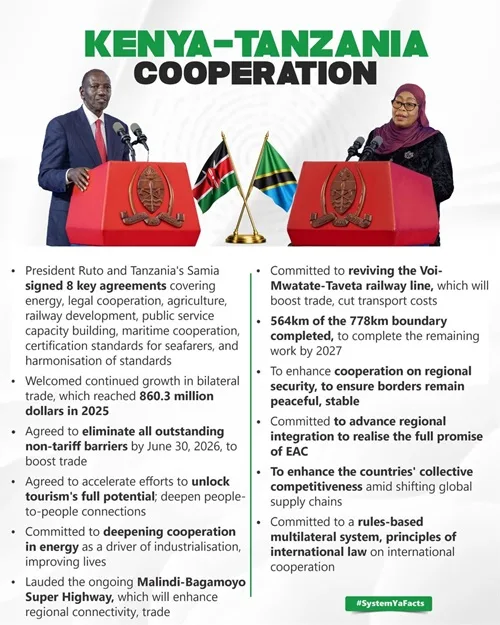
Tanzanian President Samia Hassan did not appear too pleased that William Ruto announced the Tanga regional oil refinery project in her country without consulting with her first. She called for mutual respect, transparency, and coordinated decision-making on strategic regional projects.
“I said Kenya and Tanzania are joined at the hip, maybe even the whole leg. Imagine a couple joined at the hip; if one runs and the other drags, you both fall. Whatever one wants to do, if the other is not willing, it won’t work. We must move in sync.”
Tanzania President Samia Hassan
Ruto underscored the importance of trust, commitment, and consistency to achieve #RegionalIntegration. Created in 1967, the EAC collapsed in 1977 due to the failure to sustain a shared vision and prioritize collective interests. Today, the EAC member states share common issues such as poverty, unemployment and underdevelopment that could be better addressed in a holistic manner by building regional value chains (#RVC).
Swahili is spoken in several countries in the region, with Kenya, Tanzania, Uganda, Rwanda, Burundi, and the Democratic Republic of Congo all using the same language. By working together, the regional community can do things on a larger scale and unlock greater opportunities.