
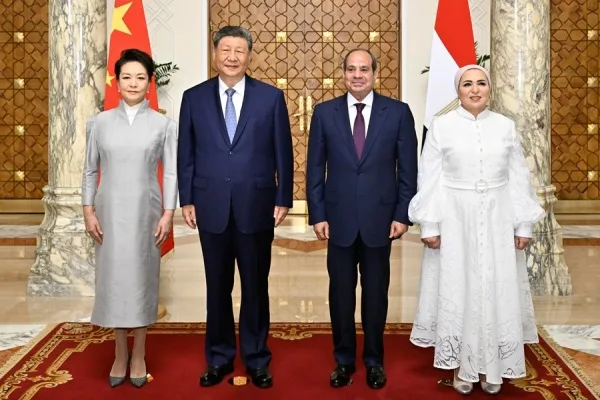
Xi’s Historic Visit to Cairo Marks 70 Years of China-Egypt Diplomatic Ties
From 1 to 3 September 2026, China’s President XI jinping undertook a state visit to Egypt. Breaking with protocol, Egypt’s President Abdel El-Sisi and his spouse Intissar personally welcomed Xi and his spouse PENG Liyuan at the airport with all the honors, including the mounted honor guard, local song and dance, and the indispensable 21-cannon salute.
The visit marks the 70th anniversary of the establishment of diplomatic relations between China and Egypt. Historically, Egypt was the first African country and the first Arab country to officially recognize the People’s Republic of China on the 30th of May 1956, shortly after the Bandung Conference.
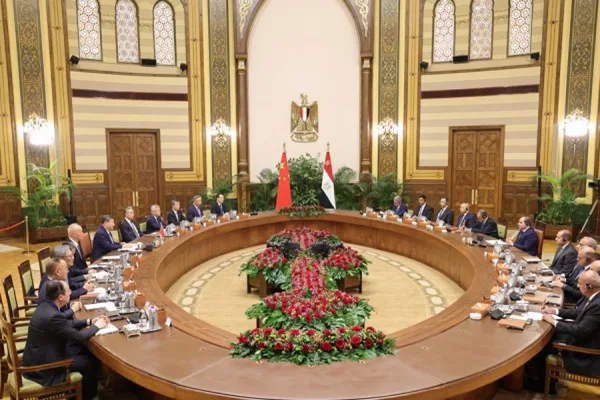
Leveraging on its geostrategic location and administering the Suez Canal that provides a shortcut on the maritime route between Asia and Europe, Egypt is positioning itself as the hub linking Africa, Europe and the Middle East. China also views Egypt as a valuable gateway to access key markets. Since the establishment of the China-Egypt Industrial Park, Chinese Foreign Direct Investment (FDI) stock has reached nearly USD 10 billion since 2008.
Presidents Xi and El-Sisi witnessed the signing of 5 core agreements and another 20 cooperation accords that expand on existing programs and extend in new areas. Thus, the main cooperation item centers on the expansion of the Tianjin Economic Development Area (TEDA). In that regard, China is encouraging a delocalization drive of certain manufacturing capabilities, in line with the industrialization policy of Egypt. Some of the new projects include the $500-million new rubber tire plant by ZC Rubber Group and a battery plant by a JV between Tianneng and Mansour Group. Additionally, Huawei will supply 2,000 high-speed computing chips for an #AI data center in Egypt.
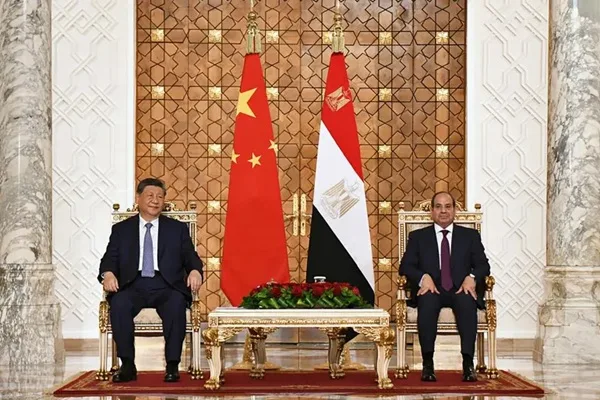
The bilateral trade volume between China and Egypt exceeded USD 20 billion in 2025, with a robust 21.5% year-on-year increase. Egypt is taking full advantage of the recent zero-tariff policy to scale up its orange exports to China, and Egyptian exports skyrocketed by nearly 200% during 1H26, compared to 1H26.
To further facilitate trade and investment between China and Egypt, the two sides agreed on a larger bilateral currency swap agreement and the expansion of the Renminbi Clearing Bank of Africa. With China’s support, Egypt plans to build up the whole electric vehicle ecosystem from tires, batteries, chassis, electronics, and other parts. It would be a win-win situation, as made-in-China goods are facing higher barriers to entry in certain markets.
The Egyptian presidential couple also accompanied the Chinese presidential couple on a tour of the recently upgraded Grand Egyptian Museum near the pyramids of Giza. In 2025, approximately 360,000 Chinese tourists visited Egypt, representing a strong 20% year-on-year increase.
But that number only represents 2% of Egypt total tourist arrivals and both sides believe that there is still much room for growth. The Egyptian Tourism Authority targets one million Chinese tourists by 2030. Already, Cairo has direct flights to Beijing, Shanghai, Guangzhou, to name a few, and more direct flights are being considered. Similar to Dubai, Egypt would like to position Cairo as a air transit hub for onward travel into the region and beyond.