

Russia to Assist Ethiopia to Build First Nuclear Power Plant
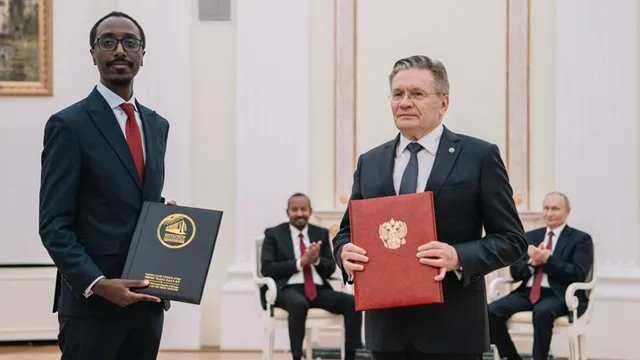
On 25 September 2025, Ethiopia signed a cooperation agreement with Russia to build a nuclear power plant. The signature took place in Moscow during the official state visit of Ethiopian PM Abiy Ahmed in Russia in the context of the World Atomic Week 2025 (#WAW2025). Ethiopian Electric Company CEO Ashebir Bacha and Rosatom Director General Aleksei Likhachev signed the document, under the watchful eyes of PM Ahmed and President Putin.
According to the communique issued by Russian state media, the Agreement called upon the two sides to come up with a roadmap for the technical and economic particulars of the project. The Agreement also includes civil nuclear capacity building and relevant knowledge transfer from Rosastom to the Ethiopian Electric Company.
“With more than 130 million people, we cannot afford to wait. Nuclear energy is essential to secure long-term development, diversify our energy mix, and realize Ethiopia’s potential. That’s why we have chosen to pursue the peaceful use of nuclear energy with seriousness and alignment with international standards. We’re also enjoying a huge amount of support from the International Atomic Energy Agency (IAEA), which is our partner on building this project.”
Ethiopia PM Abiy Ahmed
During his keynote address at the Global Atomic Forum in the context of #WAW2025, PM Ahmed presented Ethiopia as a champion in the field of the #EnergyTransition. As a matter of fact, Ethiopia recently commissioned the Great Ethiopian Renaissance Dam (GERD) with a capacity of 5.2 GW. Ethiopia is willing to explore other low-carbon power source in its energy mix such as nuclear. With nuclear energy, the risk of radiation leaks is non-zero, but the technology has advanced further to make the risk smaller.
With the assistance of Russia, Ethiopia also plans to establish a Nuclear Science and Technology Center to promote the peaceful applications of nuclear science. Evidently, the safety aspects of the nuclear training will also not be neglected. The 2017 agreement on cooperation nuclear energy, in the fields science, technology and education, planted the seed for today’s nuclear power plant project.