
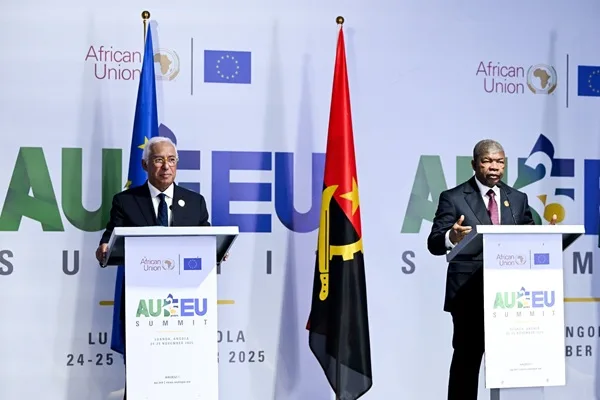
Minerals and Migration Dominate 7th AU-EU Summit 2025 in Luanda
The 7th AU-EU Summit (#AUEU2025) convened in Luanda, Angola, from 24 to 25 November 2025, under the theme of “Promoting Peace and Prosperity Through Effective Multilateralism.” In a world being tossed around by unilateralism, multilateralism is becoming as valuable as #RareEarths. 2025 also marks twenty-five years of formal dialogue between the African Union and the European Union since the inaugural Summit in Cairo back in 2000.
From the trade in goods perspective, the EU has been losing ground for the past few years. In 2022, the trade volume was €408B, the figure fell to €367B in 2023, and in 2024, it was €355B. The EU is the largest trading partner of the AU, but it risks being overtaken by China in the foreseeable future, given the current trends.
“The EU-AU partnership has a clear purpose: to strengthen and enrich the bond between our people. To make our natural connection even stronger. So that we can grow together and protect each other.”
EU President Antonio Costa
Africa has 30% of the world’s reserves of #CriticalMinerals that Europe needs for its #EnergyTransition. Therefore, there appears to be a natural complementarity between the two regions. However, there is intense competition for these strategic resources, such as cobalt, copper, lithium, manganese, graphite, as well as #RareEarths.
“Europe has everything to gain from partnership and cooperation with a developed Africa, one that does not send illegal immigrants to European countries across the Mediterranean Sea and does not constantly need to ask for donations and debt forgiveness.”
AU Chair Joao Lourenco
At the same time, Africa aspires to graduate from being a low-value raw minerals exporter to a high-value finished goods manufacturer. It could be a win-win situation as the EU aims to stem the flow of illegal migration from Africa. If Africans could lead a better life in their country, it stands to reason that they would not migrate abroad in such numbers, sometimes at great risk.
However, smelting and refining are known to be energy-intensive processes, even more so when the concentration of useful materials is low, as in the case of Rare Earth Elements (#REE). Fortunately, Africa is blessed with solar, geothermal, and other renewable energy sources, which can provide the green power required. Africa is also rich in hydrocarbons and uranium that can provide the baseload power needed for stable and affordable power necessary for its #industrialization.
“The global clean transition is now in full swing. Last year, over 90% of new energy capacity installed worldwide was renewable. Solar and wind have replaced coal as the leading sources of electricity worldwide. But out of the USD 2 trillion invested in clean energy globally in 2024, only 2% came to Africa – the continent with 60% of the world’s best solar potential. That cannot be.”
EC President Ursula von der Leyen
To date, the EU has associated itself with the USA to develop the #LobitoCorridor to facilitate access to the mineral-rich Copperbelt region, straddling Zambia and the Democratic Republic of Congo (DRC). Actually, the EU’s #GGI and the G7’s #PG2I are joining hands to counter China’s #BRI. So far, the EU has mobilized EUR 120 billion through the Global Gateway Initiative for a total of 138 projects across Africa.
At the 6th Summit in 2022, the EU pledged EUR 150 billion as part of the #GlobalGateway Investment Package dedicated to Africa. The target is now expected to be reached by 2027. The AU already has a pipeline of priority projects under its Program for Infrastructure Development for Africa (AU-PIDA).
“Actually, going beyond our geographical proximity, Africa and Europe not only share a common history, but also share common interests in multiple arenas. We also have several centuries of history. Africa is thus counting on Europe to open the tap of impact investments to achieve transformative changes.”
AUC Chair Mahmoud Youssouf
The recurring criticism is that the EU ‘talks a lot, but does very little.’ Therefore, the two parties have reached an understanding to come up with a clear implementation plan, with committed funding and a definite timeline, within six months. A permanent joint AU-EU follow-up mechanism is also necessary to monitor progress. The next Summit will take place at the EU headquarters in Brussels.