
DRC Cabinet Approves Rehabilitation of Lobito Corridor by Mota-Engil
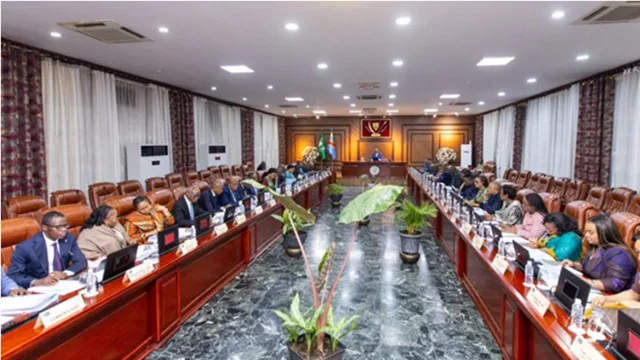
On 10 July 2026, the Government of the Democratic Republic of Congo (DRC) officially endorsed the Public-Private Partnership (#PPP) with Mota-Engil to rehabilitate and operate the Congolese segment of the #LobitoCorridor. The Deputy Prime Minister and Minister of Transport Jean-Pierre Gombo presented the project during the Cabinet meeting. Under the agreement, Mota-Engil will benefit from a 30-year concession to operate the line, once it is rehabilitated.
The Lobito Corridor is a high-priority project identified by both the USA and DRC, which then inked the DRC-USA Strategic Partnership Agreement in December 2025. The US Development Finance Corporation (DFC) also issued a letter of intent (LOI) expressing its willingness to provide financing up to USD one billion for the Project as long as it is in line with the national interest of the US.

Mota-Engil already formed the Lobito Atlantic Railway (LAR) in partnership with Trafigura and Vecturis to start work on the Angolan segment of the Lobito Corridor. The Congolese segment is about 715 kilometers and starts at Luau and Dilolo located on the Angolan and Congolese sides of the border, respectively. The first section from Dilolo to Kolwezi is 450 kilometers long. Then, the rail continues to Tenke and Lubumbashi, before finishing at Sakania on the border with Zambia. This new agreement will allow seamless cross-border connectivity from the main Congolese mines in Kolwezi, Tenke and Lubumbashi.
The Kamoto Mine is a JV between Glencore and Gécamines and sits just 2 kilometers from the Kolwezi city center. The Kamoa-Kakula Copper Complex, a JV between Ivanhoe Mines and Zijin Mining, is some 25 kilometers west of Kolwezi. The Tenke Fungurume Mine and Kisanfu Mine owned by China Molybdenum (CMOC), are respectively 95 kilometers and 45 kilometers east-southeast from Kolwezi.
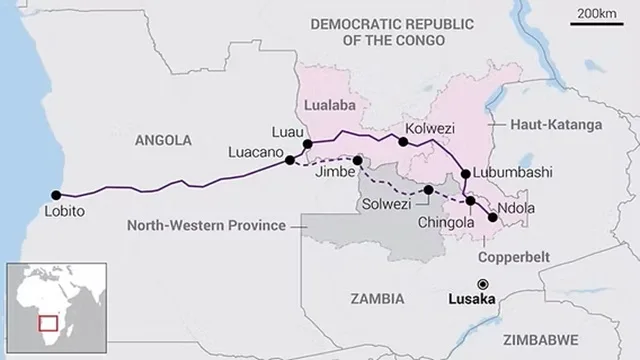
Based on the feasibility study, once operational, the Lobito Corridor rail will slash transit times from Kolwezi to Lobito to under four days, and will reduce logistical costs by up to 40%. The Lobito Corridor is designed to transport mostly copper and cobalt, which are #CriticalMinerals needed for modern industry, from the Copperbelt region to the seaport. However, the countries involved aspire to develop the Lobito Corridor into a full-fledged Economic Corridor.
The Lobito Corridor is often presented as being in competition with the Tanzania-Zambia Railway (#TAZARA). However, the situation is actually a little more complicated due to China’s part ownership in Mota-Engil and dominance in the African mining sector.
Mota-Engil (LS: EGL) is a Portuguese company founded and run by the Mota family since 1946. In 2021, China Communications Construction Company (CCCC) acquired a 32% stake in Mota-Engil. Therefore, China has stakes in both the Lobito Corridor and the Tanzania-Zambia Railway; in TAZARA, it holds the majority stake, while in the Lobito Corridor, it holds a minority, but not insignificant, share. China seems quite happy to take a back seat on the Lobito Corridor, letting the US and EU take the spotlight, while it focuses on TAZARA.
Initially, the US reacted with diplomatic fury to the entry of CCCC (SHSE: 601800) into the ownership of Mota-Engil. Realizing that Mota-Engil is the only major Western company with the wherewithal to undertake the Lobito Corridor Project, the US quickly changed its tune and adopted a more pragmatic attitude.
In the same vein, there is another initiative to build a greenfield line from Angola to the #Copperbelt on the Zambian side. At the start of July 2026, the Africa Finance Corporation announced the Financial Close for funding the upgrade of the Angolan segment of the Lobito Corridor. On the other side, the TAZARA modernization has taken a head start with ‘boots on the ground’ at both ends of the line at Kapiri Mposhi and Dar es Salaam.