

The China-Maldives Free Trade Agreement Effective as of 1st January 2025
Following a videoconference on 30 December 2024 between Mr WANG Wentao, Minister of Commerce of the People’s Republic of China, and Mr Mohamed Saeed, Minister of Economic Development and Trade of the Republic of Maldives, it was decided that the Sino-Maldivian Free Trade Agreement (#FTA) will take effect as of the 1st day of January in the year 2025.
Based on the FTA, goods exported by China to the Maldives, such as electrical equipment, construction materials and furniture will enjoy preferential access. Similarly, goods exported by the Maldives to China, such as seafood, will also enjoy duty-free access to the Chinese market. In addition, the Maldives will have the possibility to even import seafood and undertake Local Value Addition (#LVA) before re-exporting to China, which is a ‘special provision’ on the China-Maldives FTA.
The ocean around the Maldives is rich in skipjack tuna, yellowfin tuna, grouper, and sea cucumber, the latter being considered a Chinese delicacy. However, prawns and lobsters are not available in abundance and even have to be imported into the Maldives. In total, some 296 categories of seafood are covered by the FTA. On the other hand, more than 90% of Chinese goods will be exempt from customs duties.
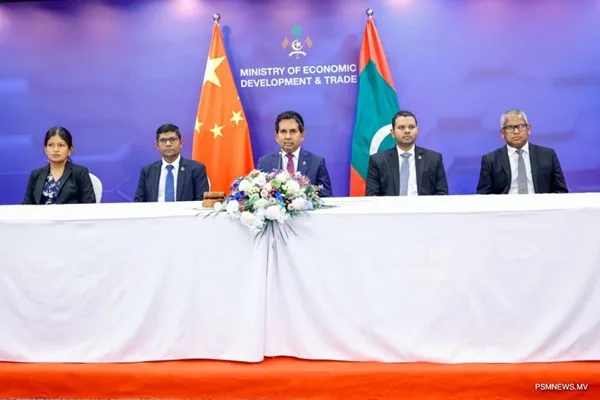
“This Free Trade Agreement will fully protect the place of the people of Maldives in our fisheries industry. What is the benefit, the joy and the opportunity? We are getting the opportunity to export all the fish and seafood we can catch to the world’s largest market without any tariffs.”
Maldivian Minister of Trade Mohamed Saeed
In 2022, China’s exports to the Maldives amounted to about USD 552 million, while Maldives’ exports to China were a paltry USD 67,300. In 2023, the Chinese exports jumped to USD 758 million.
China and India are neck and neck in terms of exports with both enjoying approximately the same level of 16% of total exports with the island nation. However, India accounts for over 70% of all exports from the Maldives, while exports to China are currently at a nearly insignificant level.
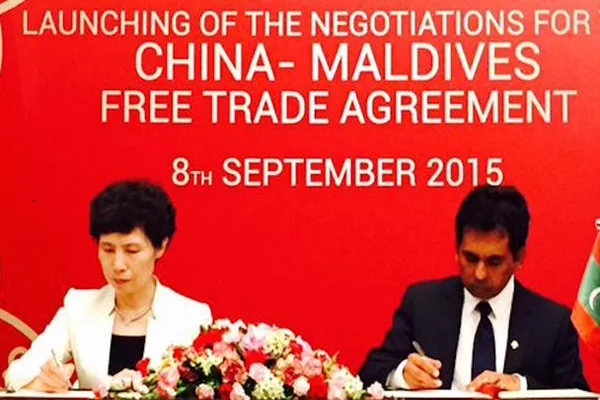
Going back in history, China and the Maldives had signed an FTA as far back as 2014. Negotiations on the new Sino-Maldivian FTA officially kicked off on 8 September 2015, and the Maldivian Parliament approved the FTA in 2017. However, the change in government in 2018 triggered a rethink of the deal and caused a delay in its implementation.
Observers note that the roller coaster ride experienced by the China-Maldives FTA is a reflection of the intense geopolitical rivalry and war of influence between China and India over the Maldives. The Maldives has joined China’s Belt & Road Initiative (#BRI) and Global Development Initiative (#GDI), but is also part of India’s #NeighborhoodFirst and #SAGAR programs. Depending on the diplomatic inclination of the government of the day, certain deals would progress or get stalled.
After President Mohamed Muizzu assumed office in November 2023, he reactivated the talks on the China-Maldives FTA. With the new accord in place, it is hoped that bilateral trade will reach the billion-dollar mark while reducing the gross trade imbalance.