
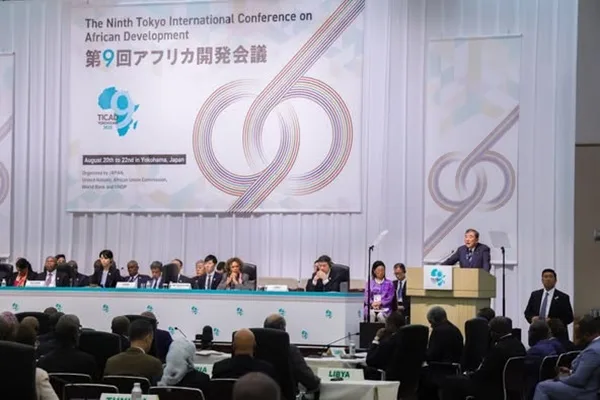
Key Takeaways from TICAD9 Summit 2025
The 9th Tokyo International Conference on African Development (#TICAD2025) took place in Yokohama, Japan, from 20 to 22 August 2025. Forty-nine African countries were represented, including 33 heads of state or government as well as representatives from the UN, AU, and other international organizations.
This 9th edition of #TICAD was co-chaired by Japanese PM ISHIBA Shigeru and Angolan President Joao Lourenco in his capacity as AU Chair. Although the total number of attendees has not yet been released publicly, the #TICAD2025 Youth Forum reported some 400 participants. Altogether, Japan signed 300 cooperation agreements with African countries at #TICAD9.
The leaders reiterated that the objectives of TICAD must be aligned with the AU #Agenda2063 and UN #SDG. The #AfCFTA would act as a key instrument to attract investment and introduce innovation into one of the largest single markets in the world.
The AU has been deploring that the current global financial architecture is biased, raising the cost of capital. Therefore, a new African Credit Rating Agency. In addition, African countries are now able to secure financing through the listing of #SamuraiBonds on the Japan Stock Exchange.
The action plan from the Summit can be summarized as follows:
- Promote Japan-Africa Co-Creation for Industry
- Endow the Enhanced Private Sector for Assistance (EPSA) fund up to $5.5B
- Mobilize $1.5B in impact investment through JICA
- Train 300,000 Africans over the next three years, with particular focus on #AI
- Attract investment in healthcare via the African Healthcare Investment Promotion Package
- Support vaccine supply in Africa via a contribution of $550M over the next five years to #GAVI
- Establish a joint Public-Private Academic Study Group to strengthen Japan-Africa Economic Partnership
- Improve learning for 10 million children and train 150,000 educators
- Launch Indian Ocean – Africa Economic Initiative
- Realize the virtuous cycle of peace, stability and growth via the Africa Mine Action Platform
- Promote Women, Peace and Security (WPS)
- Ensure stable supply of #CriticalMinerals, such as Platinum, Cobalt and Copper, via the Resilient and Inclusive Supply-chain Enhancement (RISE) program
- Develop logistics along the #NacalaCorridor to streamline mineral resource supply
During his welcome address, PM Ishiba recounted how a drone delivery solution developed in Rwanda was adapted to solve a problem in Japan. As Japan has an ageing population, many senior citizens require regular medication. A particular challenge presented itself to the seniors residing on Goto Island in the Nagasaki Prefecture. Delivery by conventional means was expensive and unwieldy; therefore, drone delivery offered a practical and cost-effective solution. It is thus wrong to assume that it is a one-way street: Japan is also learning from Africa.
“Now, we are entering an era when solutions originating from Africa will save the international community, including Japan. Japan wishes to remain a reliable partner that walks together with Africa, providing solutions to one another. As proof of Japan’s commitment to action, I would like to report that more than 300 cooperation documents have been concluded this time. Japan believes in Africa’s future and will promote investment in Africa.”
Japan PM Shigeru Ishiba
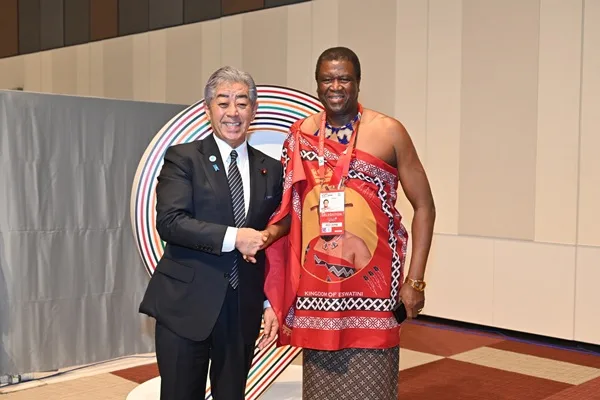
The presence of a representative from Western Sahara did not go unnoticed. Morocco claims Western Sahara as its territory, whereas the African Union (AU) recognizes Western Sahara as a separate state.
Japan pledged a financing package of USD 30 billion at the last #TICAD Summit in Tunis, but it is not clear how the financing has been appropriated. Japan did make public some video clips about certain projects in Africa, but the tally appears to fall well below the mark. This time, Japan has announced only USD 5.5 billion of financing via the #EPSA.
The next venue for the TICAD Summit has not been announced yet, but as per convention, it should be the turn of an African country to host the next TICAD10 Summit in three years. In the meantime, one can expect ministerial-level follow-up meetings or other high-level consultative meetings.