
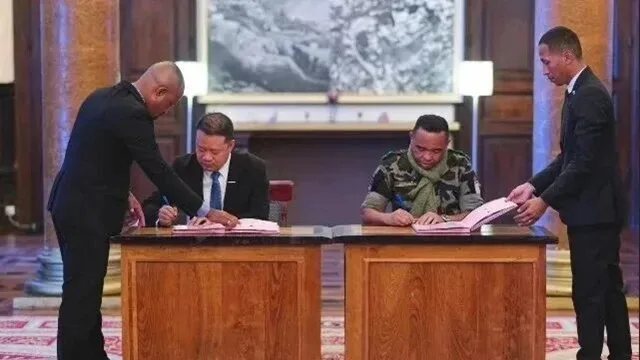
Tsingshan Signs MoU Pledging $10B to Develop Mining Sector in Madagascar
On 6 February 2026, at the Iavoloha Presidential Palace, Tsingshan and the transitional Government of Madagascar signed a Memorandum of Understanding (MoU) to cooperate to develop the mining sector. The President of Madagascar Colonel Michael Ranjaneri and Tsingshan Madagascar GM, SUN Jianqiang, led the two sides and signed the Memorandum
The scope of cooperation covers exploration, extraction, processing, as well as related infrastructure. It also includes the development of an industrial zone specializing in mining. Initially, Tsingshan has set its eyes on iron ore, since the company already has similar operations in Zimbabwe. In the future, it is not excluded that Qingshan might move into other minerals.
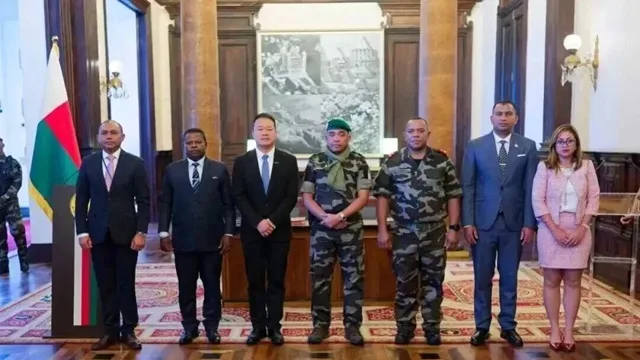
President Ranjaneri underscored that the cooperation is aligned with the development strategy of Madagascar, which is rich in mineral resources. Therefore, the Government of Madagascar fully supports the sustainable and responsible development of the mining sector to bring benefits to its people.
On his part, Tsingshan GM Sun highlighted his company’s commitment to smart and green mining. The benefits will extend well beyond mining thanks to the construction of highways, railways, seaports, and the building up of industrial capacity.
“This project is not just another mine or factory. It has the potential to fundamentally change our economic structure. The stated goald is clear: transition from an economic model centered on the export of raw materials to a processing-based economy based on value creation.”
Malagasy Government Spokesperson
According to the MoU, the total Foreign Direct Investment (FDI) could exceed USD 10 billion, eventually. Some 100,000 jobs are forecasted to be created upon completion. A piece of land covering 5,000 hectares has been identified in the Atsima Andrefana region in southeast Madagascar for the industrial park.
Some old hands cautioned against the nature of such an MoU, which is less of a contractual obligation and more of a declaration of intention. Firstly, the government is transitory, and a new duly elected government may not recognize it. Then, there is no definite timeline for disbursements, which signals weak commitment for realization; and even if implemented, it could only be a partial one, at best.