
Russia and India Send Signals as Putin Visits India Amidst Tensions
From 4 to 5 December 2025, Russian President Vladimir Putin was on a state visit to India in the context of Western sanctions on Russia and punitive tariffs by USA on India. In addition to traditional cooperation sectors of Energy and Defense, the visit is aimed at broadening the scope of partnership as a way to mitigate geopolitical risks and economic sanctions.
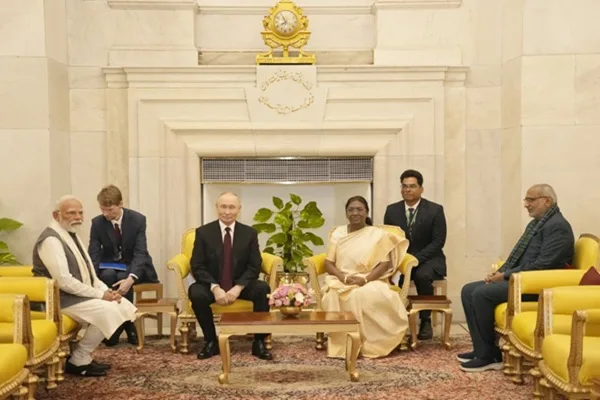
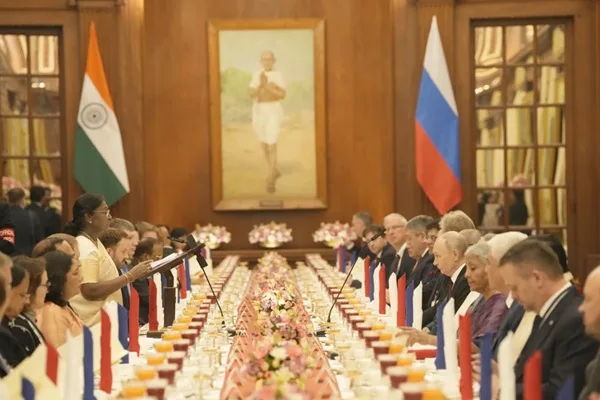
It was quite telling that Indian PM Narendra Modi broke protocol to personally welcome President Vladimir Putin right at the airport. As per protocol, the formal welcome ceremony took place at the Rashtrapati Bhavan in the presence of both Indian President Droupadi Murmu and PM Narendra Modi. Other than the tete-a-tete with Modi, Putin also had a working session with Indian President Droupadi Murmu. In the evening of the 5th of December 2025, the delegation led by Putin was convened to a state banquet. President Putin paid respect to Mahatma Gandhi at the Rajghat.
For the moment, the bilateral trade is very much in favor of Russia due to the large purchases of Russian hydrocarbons by India. In addition, the two countries plan to expand the use of national currencies to settle bilateral trade, allow cross-border digital payments, and explore the connection of both countries’ Central Bank Digital Currency (#CBDC) platforms. Putin also attended the India-Russia Trade Forum to promote economic cooperation between the two sides.
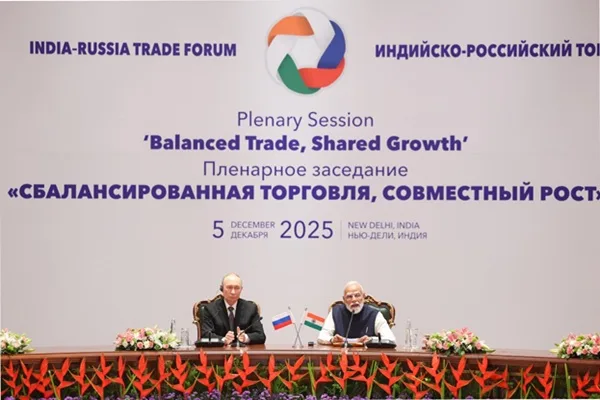
During the visit, the two countries signed several agreements and memoranda of understanding:
- Manage Temporary Labour
- Combat Irregular Migration
- Cooperation in the field of Healthcare as well as Medical Science and Education
- Cooperation on Food Safety
- Cooperation between the Department of Posts of India and the Russian Post
- Cooperation between the University of Mumbai and Lomonosov University in the field of Investment
- Cooperation between Prasar Bharati and Gazprom Media
- Train mariners to operate in Polar Waters
- MoU between India’s Ministry of Ports and the Maritime Board of the Russian Federation
- MoU between M/s Rashtriya Chemicals & Fertilizers, Indian Potash, National Fertilizers, and M/s JSC UralChem
- MoU between the Defense Institute of Advanced Technology in Pune and the Federal State Autonomous Educational Institution of Higher Education in Tomsk
- Protocol Between Indian and Russian Customs to exchange pre-arrival information on goods and vehicles
India plans to procure more Russian defense equipment, such as fighter jets, missiles and submarines. In addition to the Kudankulam Nuclear Plant in Tamil Nadu, the two sides explored extending cooperation in the field of nuclear technology to the fields of medicine and agriculture. India is keen to have technology transfer from Russia in order to beef up its defense and nuclear capabilities.
The visit is widely interpreted as a signal that India and Russia intend to maintain, even deepen, their ‘special, strategic and privileged partnership’, much to the chagrin of the West. In line with its declared foreign policy of ‘multi-alignment’, India is maintaining ties, albeit recalibrated, with both Russia and the US. Indeed, India and Russia agreed to step up bilateral trade with a target of increasing the volume from USD 68 billion in 2025 to USD 100 billion by 2030.
Modi presented Putin with a Russian version of the Bhagavad Gita, an Indian religious literary classic, as well as a taste of what best India has to offer, such as the prized Kashmiri Saffron, the delicious Assam Tea with an ornate tea set, and an exquisitely handcrafted Silver Horse. The Bhagavad Gita is a nod to India’s philosophy, while the majestic horse is an image for the enduring and strengthening of the India-Russia relationship.