
China Sets Sight on Self-Reliance, Innovation and Prosperity for 15th Five-Year Plan at Two Sessions 2026
Two Sessions 2026 and 15th Five-Year Plan
As is the tradition every year in March, the CPPCC and NPC meetings, known as the #TwoSessions, kicked off on 3 and 4 March 2026. The Two Sessions 2026 (#TwoSessions2026) is expected to last about one week and is expected to end on the 11th of March 2026. The particularity of this edition is that it coincides with the start of the 15th Five-Year Plan (#FYP15), spanning from 2026 to 2030.
Internal and External Challenges
The Chinese Government recognizes that the current environment presents many challenges. Internally, China faces a demographic decline and an ageing population. Enterprises are complaining about excessive competition that is creating razor-thin margins and raising concerns from international trade partners. The housing glut and price collapse in real estate have made Chinese citizens uneasy and feel ‘less rich.’
Externally, China faces a trade war with the USA, and national protectionism poses a risk for global trade. Recent events in Venezuela and Iran have prompted China to diversify its energy sources and accelerate its #EnergyTransition.
Made in China 2025
The Made in China 2025 (#MIC25) program set the bar and aimed to grow Chinese companies into global champions. Today, #MIC25 is believed to be largely successful as China reinforced its position as the ‘Factory of the World’ by increasing its share of global manufacturing from 25% in 2015 to 30% in 2025. as Chinese leads in shipbuilding, high-speed rail, photovoltaic panels, wind turbines, electric vehicles and energy storage systems.
However, some notable gaps persist in semiconductors, advanced materials, and passenger jets. In the military sphere, China is still lagging in terms of a blue navy and nuclear deterrence, although massive resources are being allocated to close the gap. Moreover, due to backlash, China toned down the official #MIC25 rhetoric, but the underlying goals remain with the new Five-Year Plan retaining some flavor of Made in China 2.0.
Macroeconomic KPI
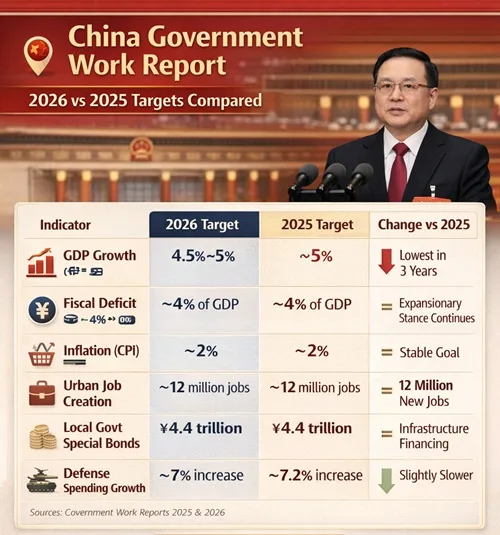
Given the challenging circumstances, #GDP growth is allowed to fall within a range of 4.5% to 5%, rather than the hard target of 5% in the previous year. Budget discipline will be maintained with the deficit within 4% of GDP. Inflation will be controlled at around 2%. Defense spending will be slightly lower at 7%, compared to 7.2% in 2025. At least 12 million new jobs will be created in urban areas.
Compared to the previous Two Sessions in 2025, the macroeconomic targets mostly did not change. This would signal that the Chinese Government is privileging stability and consistency during these tumultuous times.
Pure GDP Growth to Balanced Quality Development
While previously, local government cadres were assessed mostly on GDP growth, the assessment will now favor high-quality development, which entails other dimensions such as social and environmental factors. The performance evaluation and promotion framework of cadres will thus reflect this shift.
Reforms and Optimization
In view of the tough times, the Central Government wants to optimize the economic structure, rather than simply throw money at a problem in the hope that it will get better. In so doing, the Chinese Government wishes to avoid duplication, efficient allocation of limited resources, and unproductive involvement.
One of the flagship reforms is the creation of a Single Market for Electricity across China. This will allow the solar-generated energy from the Gobi desert to be transmitted and sold where it is needed. It will also allow the power generated from the mega hydropower plants to be sent to where it is most needed.
To prevent wastage and duplication, the Central Government is also promoting the coordinated development of cross-provincial cities and regions. The Greater Bay Area in the South, the Beijing-Tianjin-Hebei region in the South, the Yangtze River Delta in the East, and the Chongqing-Sichuan Corridor in the West are the identified regions that could benefit from a more closely coordinated planning and development.
Technology Self-Reliance
The #FYP15 highlighted several sectors and technologies where China will work to achieve self-reliance. The sectors are considered critical for national security and economic competitiveness. They include:
- Artificial Intelligence (#AI)
- Semiconductors and Integrated Circuits
- Robotics and Humanoid Robots
- Low-Altitude Economy and Drones
- 6G Telecommunications
- Aerospace
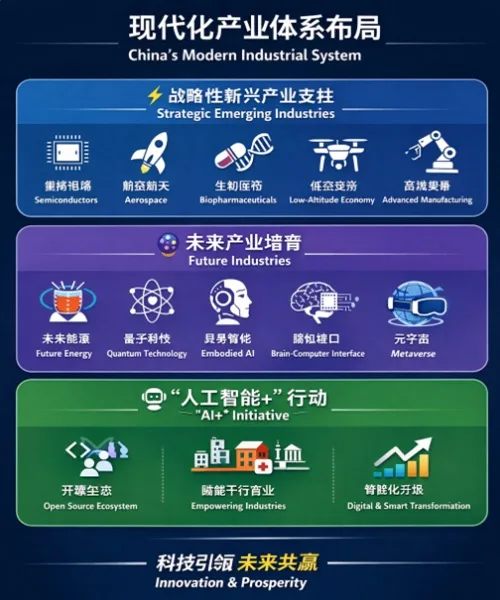
The Government plans to allocate 3.2% of GDP to Research and Development. Under the AI+ initiative, China will foster the adoption of AI and robotics in a variety of sectors. China has decided to adopt an open-source model to foster cooperation, foster innovation, and offer certain innovations as a public good. Thus, it has opened the source souce of its AI and Quantum Computing engines.
Emerging Industries
In addition to the above, China highlighted a number of emerging industries that can contribute to its growth in the future. These are sectors where China aims to achieve leadership and they include:
- Quantum Computing
- Biotech and Pharma
- Future and Clean Energy, including Green Hydrogen and Fusion Energy
- Metaverse, VR & AR
- Brain-Computer Interface
- Embodied AI
Energy Transition and Net Zero
China maintains its target to achieve NetZero by 2060 and is accelerating its decarbonization drive. Thus, the target of 3% reduction of carbon has been upgraded to 3.8% reduction of carbon per percentage point growth in GDP. To achieve this, it will continue to promote new and green energy sources such as solar (#PV), wind, hydrogen, and nuclear.
China is pushing for the adoption of Electric Vehicles in the domestic as well as overseas markets. It is worth noting that BYD has surpassed Tesla in terms of total #EV sales. The US-Iran conflict has firmed up China’s resolve to foster renewable energy sources.
Housing Crisis and Local Government Financing
Real estate used to account for a major share of the revenues of Local Governments, but with the housing glut, that revenue stream has basically stopped. Therefore, the Central Government will allow Local Governments to raise financing via Special Bonds to the tune of RMB 4.4 trillion. The proceeds will go mainly to fund infrastructure improvements.
Social Measures and Domestic Consumption
To reverse the demographic decline, China is incentivizing child births, and this year, it plans to experiment with flexible working conditions for parents. Additionally, organizations are encouraged to spread and extend holidays in a bid to boost tourism. In accordance with its means and needs, China plans to improve its pension and social coverage to bring back consumer confidence.
At the same time, to further boost consumption, China launched the ‘swap the old for the new’ campaign. However, the annual budget for this particular measure has been trimmed from RMB 300 billion in 2025 to RMB 250 billion.
Strategic Objectives
The #TwoSessions2026 set the tone for the new chapter, and the #FYP15 provides direction for future development. China aims to become a prosperous and innovative nation by 2035, while taking into consideration the challenging global environment.
China is striving to shed its image of the ‘factory of the world’ for low-cost, low-quality commodities to become a ‘global innovation hub’, creating high-value, #hitech products.