
India’s Union Budget 2026-2027 Inspires by Three Kartavya
Symbolism and Special Date
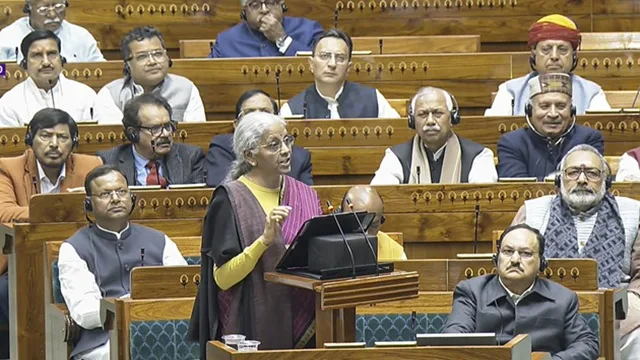
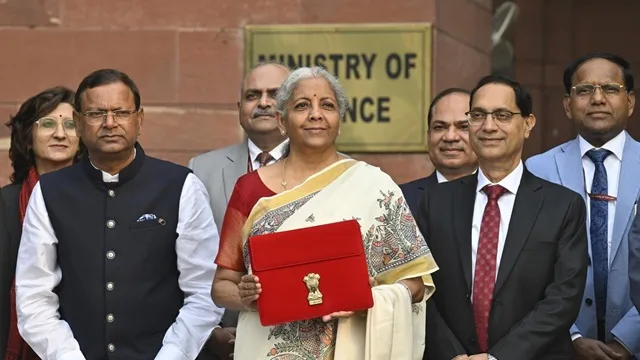
On 1 February 2026, the Indian Minister of Finance Nirmala Sitharaman presented her 9th Union Budget 2026-2027 in Parliament. The first of February fell on a Sunday and was chosen for the occasion to coincide with Magha Purnima and the birth anniversary of Guru Ravidas. It is also the first Budget prepared in the freshly inaugurated Kartavya Bhavan within the Common Secretariat Complex, designed to enhance inter-ministerial coordination and to accelerate policy implementation.
Inspiration from Sabka Sath and Sabka Vikas
The Budget is inspired by the Three Kartavya, which means Duty in Sanskrit. The first is to accelerate and sustain economic growth by enhancing competitiveness and productivity in a context of volatile global dynamics. Second Kartavya is to fulfil the aspirations of Indians through capacity building and making them partners in the path to prosperity. Last but not least, the Budget is aligned with Sabka Sath and Sabka Vikas to ensure a balanced development across regions and sectors and that ‘no person or community is left behind.’
Macroeconomic KPI
The #GDP growth is set at 10% for the upcoming financial year 2026-2027. The Capital Expenditure (#CAPEX) by Central Government will be incrased to INR 12.2 lakh crore (3.1% of GDP) to drive infrastructure construction. Fiscal consolidation will continue with a deficit within 4.3% of GDP.
Reforms
The key reforms pertain to reducing the fiscal burden, streamlining administration, and prevent misuse. Thus, the New Income Tax Act that comes into on the 1st of April 2026 will make the language simpler and easier to implement. The Securities Transaction Tax on Futures and Options have been respectively increased to 0.05% and 0.15% to curb excessive speculation. On the other hand, the Tax Collected at Source for Overseas Education and Medical Treatment has been reduced from 5% to 2%. Similarly, the Tax Collected at Source for Overseas Tour Packages is now capped at 2% regardless of the amount.
Infrastructure
India has identified seven new high-speed rail (HSR) corridors, known as Growth Connectors, across the country. Similarly, it is worth highlighting the construction of Dedicated Freight Corridors linking Dankuni on the East to Surat in the West and the operationalization of 20 new National Waterways. To support the City Economic Regionsm, the Central Government will allocate INR 500 crore per CER to give an boost to Tier-2 and Tier-3 cities.
Boost to Emerging and Frontier Sectors
India has identified Biopharma, Textile, Semiconductor & Electronics as key sectors for its future growth. Thus, under the Biopharma SHAKTI (Strategy for Healthcare Advancement through Knowledge, Technology and Innovation), the Ministry will allocate INR 10,000 crore to make India into a global biopharma manufacturing hub. India is also launching the India Semiconductor Mission 2.0 to foster indigeneous materials and equipment manufacturing with India intellectual property (IP). The related Electronics sector will benefit from a boost in outlay of INR 40,000 crore, compared to the previous INR 22,919. The Central Government will make new incentive schemes targeted to modernize the Textile Sector in order to make it more competitive and productive.
Traditional Sectors
India is launching the Bharat-VISTARR which is an AI-powered multilingual tool to provide localized and customized advisory services to farmers. The Central Government will the creation of five regional medical hubs to position India as a leader in Medical Tourism. To support the health sector, the Government plans to train 1.5 lakh health workers and caregivers annually.
Sustainability
To boost decarbonization, India will exempt customs duty on the import of capital goods in the manufacture of PV panels and Energy Storage Systems (ESS). At the same time, it will encourage the deployment of residential rooftop solar panels. An enhanced policy framework for ‘Waste-for-Wealth’ to promote the Circular Economy for #CriticalMinerals by building up capcity for #lithium battery recycling.
Strategic Direction
As many analysts observe, the Union Budget 2026-2027 aims to ‘catapult India on its new growth trajectory’ while maintaining fiscal prudence and ensuring that tangile benefits are felt by all Indians. India is confident in its capability to weather the current global strom by mitigating risks and shocks.