
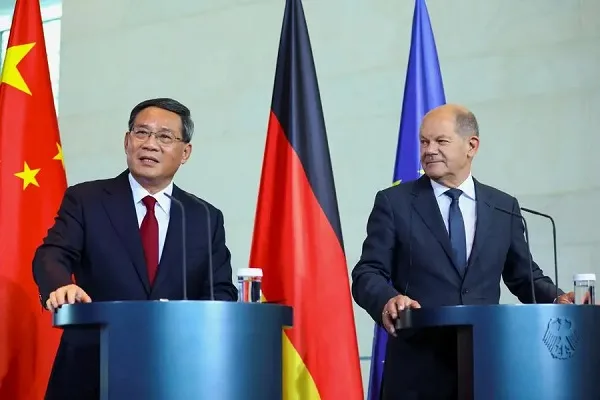
“Derisk, Not Decouple from China,” says Scholz
During the official visit of Chinese Premier Li Qiang in Germany, German Chancellor Olaf Scholz underlined Germany’s new policy vis-à-vis China. Scholz clarified that Germany and Europe, in general, need to reduce risks and dependencies on other countries, including China, by building up their self-sufficiency in certain areas and, in particular, for #CriticalMinerals which are key for industries of the future.
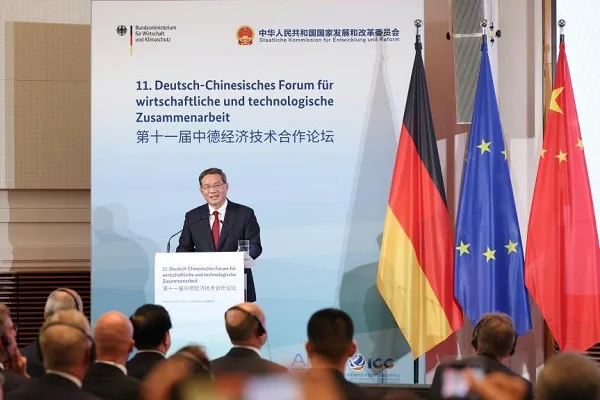
Leaving China on 18 June 2023, Li Qiang undertook a four-day visit to Germany prior to attending the Summit for a New Global Financial Pact in Paris. He is scheduled to meet with President Frank-Walter Steinmeier and Chancellor Olaf Scholz. He also attended the 7th High-Level Germany-China Government Consultations and the 11th Economic and Technical Cooperation Forum. Additionally, he paid a visit to Bavaria, the economic powerhouse of Germany, which is home to Adidas, Allianz and Audi.
“Germany and China are both partners and competitors, although the competitive element appears to be more prominent recently.”
German Chancellor Olaf Scholz
Germany’s world-famous auto industry must find alternative sources for lithium and cobalt for producing Electric Vehicles (#EV). To that effect, Germany will look for and leverage alternative sources such as Azerbaijan, Chile and Indonesia.
China is Germany’s largest trading partner, with bilateral trade volume at EUR 300 billion in 2022, and China enjoying a trade surplus of EUR 80 billion. The Chinese market makes up a significant portion of the German automakers’ global sales, with BMW and Mercedes-Benz relying on China for roughly one-third of total sales, while half of Volkswagen’s sales are in China. In fact, Volkswagen was the first foreign car manufacturer to strike a JV with Chinese firm SAIC Motor in 1984. Today, China has just surpassed Japan as the largest exporter of cars around the world.
On the semiconductor front, Germany welcomed the plan by Intel to invest more than EUR 30 billion in a chip manufacturing facility in Magdeburg. The deal came to fruition with funding support from the German government.
During the Merkel era, Germany entertained quite good relations with China. However, Scholz initially adopted a harsher tone and China was qualified as a ‘systemic rival’ in a policy paper which was recently released. However, in view of the new posture, an updated policy paper is apparently being drafted will likely be ‘more balanced.’