

US Treasury Secretary Scott Bessent Convenes Emergency G7 Critical Minerals Meeting
On 12 January 2026, US Treasury Secretary Scott Bessent convened a Critical Minerals Meeting with #G7 Finance Ministers. Other key countries such as Australia, India, Mexico, and South Korea have also been invited.
Participants included the UK Chancellor of the Exchequer Rachel Reeves, South Korean Finance Minister KOO Yun-Cheol, Mexican Finance Secretary Edgar Zamora, Japanese Finance Minister Satsuki Katayama, Italian Finance Minister Giancarlo Giorgetti, German Federal Minister of Finance Lars Kingbeil, French Finance Minister Roland Lescure, Indian Minister for Electronics Ashwini Vaishnaw, Canadian Finance Minister Francois-Philippe Champagne, and Australian Treasurer Jim Chalmers. Together, the G7 member countries account for 60% of the global demand for #CriticalMinerals.
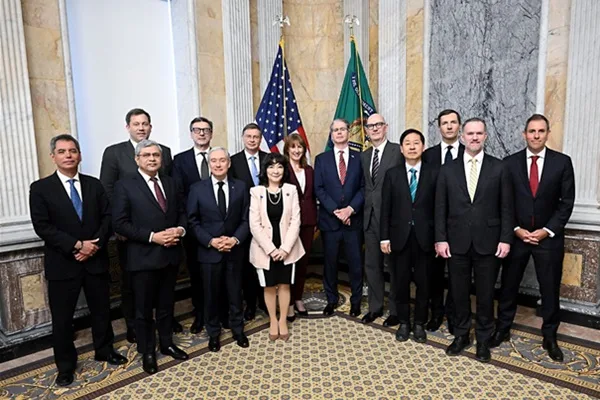
On the US side, other than US Secretary Scott Bessent, US Trade Representative (USTR) Jamieson Greer, US EXIM Bank Chair John Jovanovic, and JP Morgan MD Jay Horine were also in attendance.
The last similar meeting took place in Toronto in October 2025. In 2025, the G7 launched its Critical Minerals Action Plan (#CMAP) during the Kananaskis Summit. However, there is a sense of urgency on both sides of the Pacific as China turned the screws on Critical Minerals, and Rare Earths in particular, with export controls to the USA and Japan.
Not long after the Tiananmen Incident and the Gulf War in 1992, Chinese leader DENG Xiaoping famously uttered the prophetic remarks: “The Middle-East has oil; China has Rare Earths.” At that time, China held approximately 80% of the world’s known rare earth reserves, but today this figure has dropped to 50% as other countries make discoveries. More importantly, China now controls over 90% of the global rare earth refining.
Generally speaking, China holds the largest proven reserves of a variety of rare earths. Depending on the mineral in question, the reserves are concentrated in a handful of countries. To mention specific cases, Chile has the world’s largest reserves of #copper and #lithium, and is also a major producer of rhenium, molybdenum and boron. The Democratic Republic of Congo has the world’s largest reserves of cobalt and tantalum, occurring together naturally as coltan, and is also a major producer of copper, germanium, and lithium.
It is worth recalling that the G7-backed #LobitoCorridor is aimed at facilitating access to the Critical Minerals in the DR Congo, by bypassing the established Chinese-controlled export routes. Both the US and EU are heavily invested in that Lobito Corridor, while China is upgrading the Tanzania-Zambia Railway (#TAZARA).
Australia has taken the lead to constitute a strategic stockpile, which it says it is ready to share with other like-minded countries. Trump has set his sights on stopping the Ukraine-Russia conflict to access the mineral wealth in that region. Lately, he has reiterated his interest in acquiring Greenland as well.
US plans to support India in developing its semiconductor industry to diversify sourcing. Semiconductor and electronics are key sectors that require critical minerals such as germanium and gallium. Newly appointed US Ambassador to India Sergio Gor indicated that the US plans to invite India to join the #PaxSilica initiative soon.
The participants were on the same page regarding addressing vulnerabilities in the global supply chain of Critical Minerals, especially Rare Earth Elements (#REE). Secretary Bessent thanked the attendees for their willingness to work together toward an urgent and lasting solution for a resilient and diversified supply chain, which is free of disruption and manipulation.