
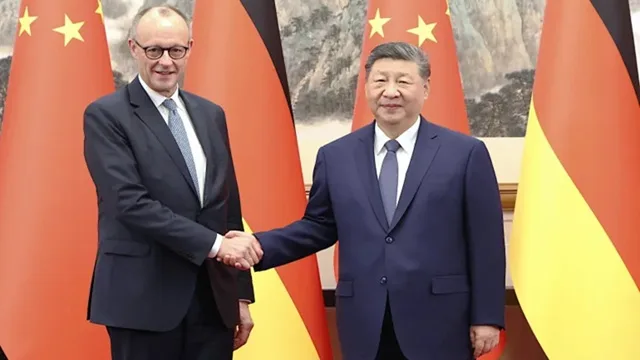
Merz Undertakes First Visit as German Chancellor to China
Frederich Merz undertook his first visit as German Chancellor to China from 25 to 26 February 2026. Since the start of 2026, a series of Western leaders, including Ireland’s PM Micheal Martin, Canada’s PM Mark Carney, Finland’s PM Petteri Orpo, and UK PM Keir Starmer, preceded Merz to Beijing.
This visit takes place in the context of trade tensions and geopolitical conflicts. It would appear that Beijing is sequencing these visits to show that it still has many friends in the West and wishes to rope in EU countries that disapprove of America’s aggressive #tariffs and predatory posture over Greenland. After Trump had slashed out at Carney following his big deals with China, Merz probably sought to strike the right balance between East and West. Despite certain divergences, engagement between China and Germany, the world’s 2nd- and 3rd-largest economies, is crucial.
Germany was one of the first Western countries to enter the Chinese market, with Volkswagen acting as a torchbearer after the ‘opening up’ in 1978. Germany contributed greatly to China’s development of its High-Speed Rail (#HSR) network. Over the years, Germany has enjoyed a trade surplus with China, which ranks as Germany’s top trade partner with a bilateral trade volume of about EUR 250 billion in 2025. Since 2020, China managed to tilt the balance of trade in its favor, and in 2025, the trade deficit is approaching EUR 100 billion.
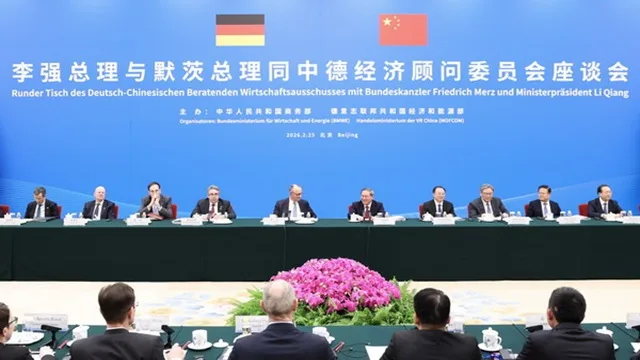
Merz was accompanied by a delegation of about 30 German captains of industry, representing Siemens, Bosch, DHL, BMW, Mercedes-Benz, and Volkswagen, to name a few. According to China’s Minister of Commerce, the two sides signed about a dozen agreements involving cooperation in agriculture, sports, climate change and media.
The largest deal is an order for an additional 120 #Airbus passenger jets. Notably, Germany carries out final assembly for the globally popular A320 family in Hamburg. Airbus has more than 50,000 employees spread across its 27 sites in Germany, representing one-third of the global Airbus workforce. On the other hand, Airbus has 10 sites in China, with a total employee count of about 2,500. The largest site is the Airbus Final Assembly Line facility in Tianjin.
The EU imposed anti-dumping tariffs on Chinese-made cars, and electric vehicles (#EV) in particular. China has moved some manufacturing to Europe and Macron underscored the need for Europe to provide market access in exchange for technology transfer and local content. In that context, Bosch and Nio signed a cooperation agreement to partner on technologies for electric vehicles and rechargeable batteries.