
Trump Immediately Reintroduces New Trade Tariff After Supreme Court Strikes Down ‘Reciprocal Tariffs’
In a judgment issued on 20 February 2026, the US Supreme Court ruled that President Donald Trump’s #tariffs policy — invoked under the International Emergency Powers Act (#IEEPA) — was unconstitutional. The Supreme Court reminds that the authority to tax does not lie with the President, but with the US Congress, as clearly stated in Section 8 of the US Constitution.
Unfazed, President Trump is resorting to the Trade Act, which allows temporary across-the-board tariffs when the US has ‘large and serious balance of payments deficits.’ Thus, the next day after the Supreme Court ruling, Trump announced a 10% global tariff. Section 122 of the Trade Act allows a maximum of 15% tariff for a maximum of 150 days, unless extended by Congress.
Given that both the House and the Senate have expressed their disapproval of the IEEPA tariffs, it looks like an uphill battle for Trump to extend the TA tariffs beyond the prescribed 5 months.
In addition, the TA does not allow the flexibility of a customized tariff rate per country, as Trump would wish to gain leverage to seal a deal. That means that compared to previously, certain countries might see their tariffs higher, whereas others might see a decrease.
Certain legal experts note that the White House has other legal options, such as the Trade Expansion Act (TEA) and the Tariff Act, that invoke national security and unfair trade. In particular, sector-specific tariffs on steel, aluminum, and automobiles (including #EV) come under Section 232 of TEA and remain in force. To impose tariffs under the Unfair Trade rationale, a due process with fact-finding and investigation must take place, and for some sectors, that is already underway.
In the meantime, many countries have requested clarifications regarding their trade deals with the US. In view of the new developments, the upcoming US-India trade talks have been postponed. However, the official visit of President Trump to China appears to be still on the agenda and is likely to take take at the end of March or beginning of April.
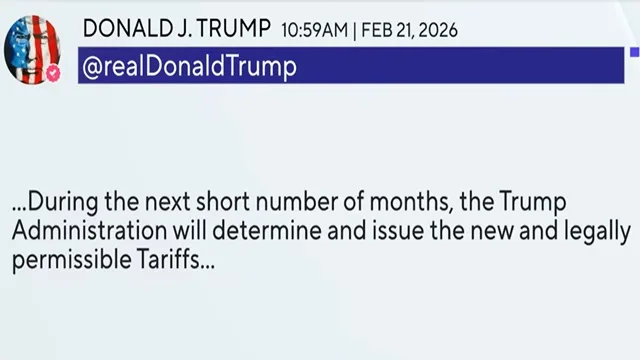
On 24 February 2026, Trump’s global tariff of 10% comes into effect, lower than the maximum 15% threatened. At the same time, US Customs will stop collecting the previous ‘reciprocal tariffs.’ Undeterred, President Trump ridiculed the opinion of the court and stated that he shall soon impose “new and legally permissible tariffs” and warn countries against ‘playing games.’