US-Iran Conflict Causes Attacks on Tankers Around Strait of Hormuz, Disrupting Global Energy Flows
The Strait of Hormuz is a well-known critical chokepoint for global energy flow. Every day, the Strait of Hormuz sees about 20 billion barrels of crude oil and 3,500 billion cubic feet (bcf) going by, representing 30% of oil and 20% of gas trade globally. When the oil markets open, the prices of petroleum are expected to spike as a consequence of the US-Iran conflict.
Since Iran was already under Western sanctions, most of its oil was exported to China, which scoops up nearly 80% of its output. From China’s perspective, Iran is a major supplier that supplies about 1.4 million barrels per day, accounting for nearly 15% of its imports, and nearly 45% of its oil needs from the Gulf States is transported via the Strait of Hormuz. Additionally, 30% of China’s liquefied natural gas (#LNG) imports are from Qatar, and that also goes through the Strait of Hormuz.
China holds an estimated half a billion barrels of strategic oil reserves, while its average daily consumption is around 10 million barrels. Therefore, China has enough stock for about 50 days. In any case, Russia is still supplying China with oil and gas, although oil supplies from Venezuela might need to be reevaluated.
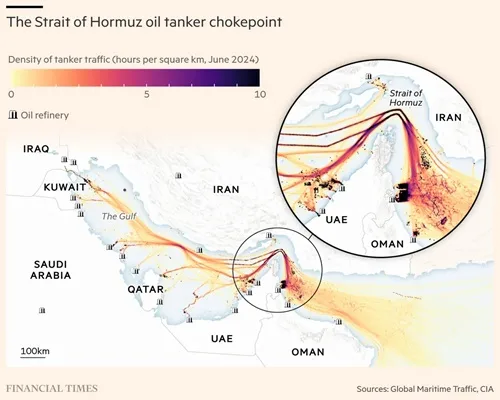
For India, 50% of its oil passes through the Hormuz Strait; for Japan, the figure is as high as 75%. Among US allies, 30% of Australian oil imports also go through the #HormuzStrait.
The Strait of Hormuz is the narrow passage point not only for oil from Iran, but also for Bahrain, Iraq, Kuwait, Saudi Arabia, and the UAE that key oil-producing countries on the coast of the Persian Gulf. Saudi Arabia has the alternative to export via its seaports on the western side, opening into the Red Sea.
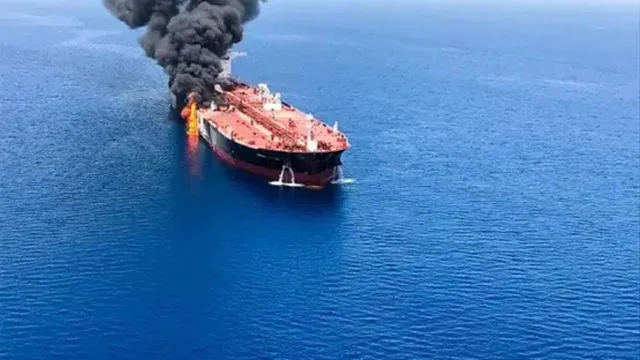
On 1 March 2026, the Islamic Revolutionary Guard Corps (IRGC) of Iran broadcast a radio message warning ships that it is blockading the Strait of Hormuz. At the time of writing, two tankers have come under attack. Skylight, registered under the Palau flag, was the first tanker to be attacked. Then, tanker MKD Vyom, under the flag of the Marshall Islands, also sent a distress signal.
Several insurance companies have already informed oil tankers that their insurance policy does not cover war conditions. Many tankers are anchored on both sides of the Strait of Hormuz. It would also appear that the satellite-based Automatic Identification Signal (AIS) for ships is being jammed, as ghost ships are being seen to move over land.
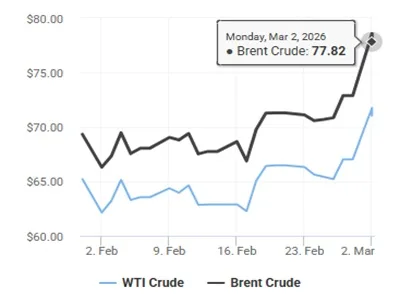
As the US assembled its armada in the Gulf region, the markets already priced in the geopolitical risk by raising the price of the oil barrel from USD 60 to 70. It is most likely that the oil will spike when oil futures markets open on Monday. At the start of 2022, oil reached USD 125 per barrel after the eruption of the Russia-Ukraine conflict over concerns about Russian oil supply.
[Updated on 2 March 2026]