
IMF Releases Economic Outlook for Sub-Saharan Africa 2026
On 16 April 2026, the International Monetary Fund (IMF) released its Regional Economic Outlook for Sub-Saharan Africa (SSA) Report. The publication of the report follows a press briefing on the Global Economy during the Annual Spring Meetings, held in Washington, DC, on the 14th of April 2026.
At the outset, the report warns that the regional bright spots are getting clouded by global tempests. Oil, gas, and fertilizer prices, as well as shipping costs, have risen sharply. Oil-importing countries will be most impacted, while the handful of oil-exporting countries in Africa might benefit from windfall gains.
The IMF predicts that, based on the 2026 growth projections, the Democratic Republic of the Congo (DRC) will surpass Ethiopia to become the 5th largest economy in SSA. The robust growth is driven by strong appetite for #CriticalMinerals, which is giving wings to trade and investment in DRC.
| Rank | Country | 2025 Nominal GDP $B |
|---|---|---|
| 1 | South Africa | 410 |
| 2 | Nigeria | 334 |
| 3 | Kenya | 141 |
| 4 | Ethiopia | 126 |
| 5 | DR Congo | 123 |
| 6 | Angola | 110 |
| 7 | Ghana | 113 |
| 8 | Cote d’Ivoire | 111 |
| 9 | Tanzania | 95 |
| 10 | Uganda | 68 |
| Rank | Country | 2026 Growth Rate % |
|---|---|---|
| 1 | South Sudan | 48.8 |
| 2 | Ethiopia | 9.2 |
| 3 | Guinea | 8.7 |
| 4 | Uganda | 7.5 |
| 5 | Rwanda | 7.2 |
| 6 | Benin | 7.0 |
| 7 | Niger | 6.7 |
| 8 | Cote d’Ivoire | 6.4 |
| 9 | Tanzania | 6.2 |
| 10 | Zambia | 6.0 |
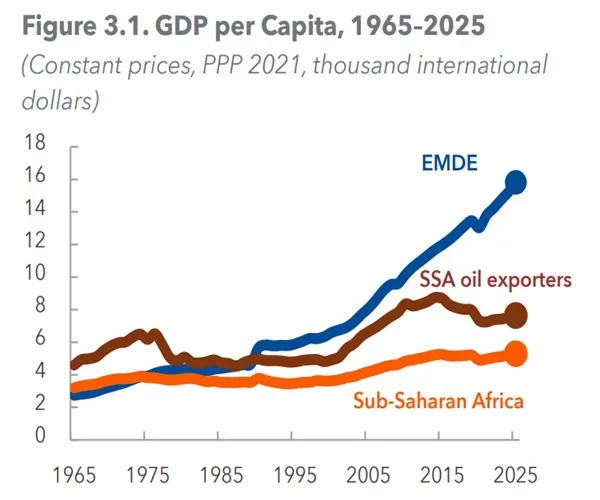
Ironically, the oil-rich countries do not necessarily do better than the oil-poor ones. Despite having some of the fastest-growing economies in the world, African economies lag behind the Emerging Markets and Developing Economies (#EMDE), which is loosely equivalent to the #GlobalSouth and includes China and India. Generally speaking, SSA is making progress, albeit at a slower rate than its real potential.
South Sudan stands out with an extremely high growth rate. However, this is a short-term outlier rather than a long-term trend since the country basically tanked in 2024, when its oil-based economy stood still due to conflict. As the situation returns to normal, the high figure reflects a rebound to pre-conflict levels.
Economies relying on tourism will likely also experience turbulent times, and hard-hit economies might have to implement social buffers. In light of the challenging situation, the IMF has had to revise its growth estimate downward. Under these circumstances, the IMF recommends addressing the immediate effects of the energy crisis in the short term and building resilience over the medium term.
The IMF has also evolved its survey strategy. Instead of only talking to the local Ministry of Finance, the IMF has also started engaging with other stakeholders. This is particularly important in comprehending why certain reforms are implemented, while others are not. Nevertheless, countries are cautious about taking the IMF’s recommendations wholesale and at face value.