
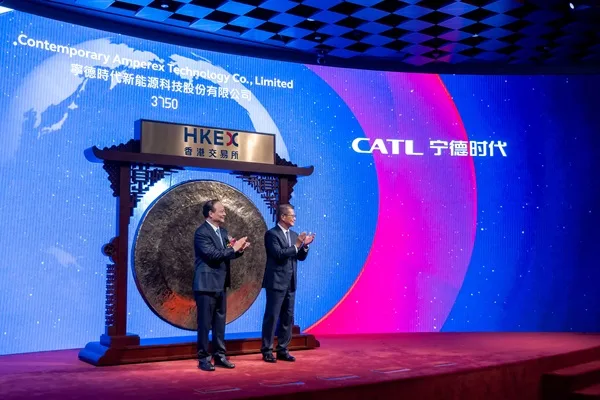
CATL’s IPO in Hong Kong Raised $4.6B, World’s Largest So Far in 2025
As one of the most anticipated initial public offerings (IPO) for 2025, CATL managed to raise HKD 35.7 billion ($4.6B) for its listing on the Hong Kong Stock Exchange on 20 May 2025. The amount of capital raised propels CATL as the largest offering globally during the year so far.
Opening at HKD 296, CATL (HKSE: 2750) closed the day on the Hong Kong market with a 16% above its subscription price. On the Shenzhen Stock Exchange (SZSE), its share price (SZSE: 300750) reversed a downward trend and ended the day with a 1.15% rise.
The appetite from global investors is quite remarkable. In January 2025, the US DoD blacklisted CATL, citing military ties; but, it would seem that this did not deter investors. China International Capital Corporation, Bank of America, Goldman Sachs, Morgan Stanley and JPMorgan Chase acted as joint lead underwriters for the Hong Kong listing.
“Europe is an exceptionally important market for CATL. The company’s growth in China was going to slow over the coming years due to already high sales penetration. Europe’s only at about 20-25% [sales] penetration, so there’s still a lot of growth there to come.”
Bernstein Senior Analyst Neil Beveridge
CATL reported that most of the capital raised from the Hong Kong’s listing will go toward its gigafactory project in Hungary. CATL is already in talks with European car makers, such as Volkswagen, Stellantis and BMW, for offtake agreements.
The expansion into Europe follows increased scrutiny and punitive tariffs from the EU and US on Chinese electric vehicles (#EV), forcing Chinese companies to delocalize their production facilities closer to the target markets. Thanks to its global expansion, CATL remains the world’s leader in battery manufacturing, accounting for nearly 40% of the global market share.
When CATL released its Annual Report 2024 in March 2025, it posted a 9.7% drop in revenue, but its net profit still went up by 15% year-on-year. The drop in revenue can be partly explained by cut-throat competition in the domestic Chinese market, which is experiencing less stellar growth as the market moves toward saturation.