
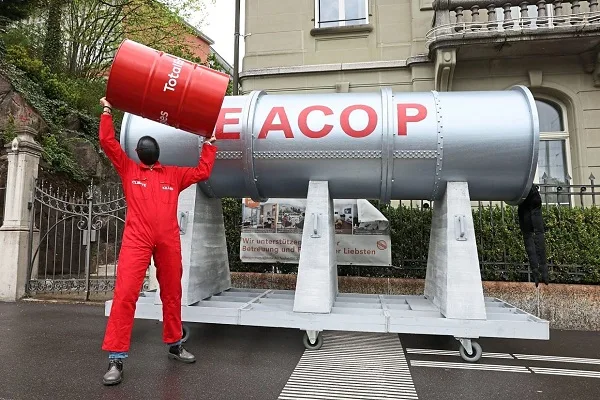
China to the Rescue of East African Crude Oil Pipeline (EACOP)
On 30 September 2023, Irene Bateebe, Permanent Secretary at the Ugandan Ministry of Energy and Mineral Development, revealed that talks with China are nearing Financial Close with regard to the East African Crude Oil Pipeline (EACOP).
It is to be recalled that the Chinese were called in after Western financiers withdrew from the project, citing strong opposition from environmental groups. Thus, China Export and Import Bank (CEXIM) and Sinosure stepped in to fill the gap. The Chinese lenders are said to be willing to provide nearly USD 2 billion out of the USD 5 billion required to build the pipeline.
“We are at the tail-end of the discussions [with Chinese lenders] for financial close. We are confident that by the end of October of this year, we will close the debt component and we would have mobilized most of the funding for the project.”
Uganda Ministry of Energy PS Irene Bateebe
The #EACOP project was conceptualized back in 2017, but land acquisition and protests initially slowed down progress. In 2021, Ugandan President Yoweri Museveni and his Tanzanian counterpart Samia Hassan signed the project cooperation agreement in Kampala.
The project is funded via 60% of loans and 40% of equity. The majority shareholder is TotalEnergies with a 62% stake. Uganda National Oil Company (UNOC) and Tanzania Petroleum Development Corporation (TPDC) each own 15%. Finally, the remaining 8% goes to China National Offshore Oil Corporation (CNOOC).
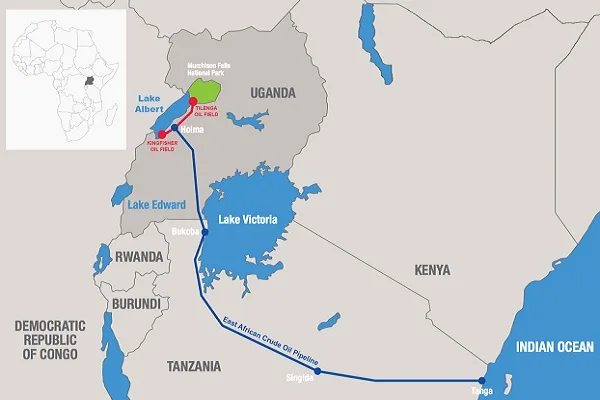
The 1,440-km long pipeline will connect the oil-rich region on the shores of Lake Albert in Uganda with the Tanzanian seaport of Tanga. The crude oil will primarily come from two oilfields: the Kingfisher Field, operated by China National Offshore Oil Corporation (CNOOC), and the Tilenga Field, operated by TotalEnergies. The pipeline will have to be electrically heated to control the viscosity of the crude oil and allow it to flow smoothly.
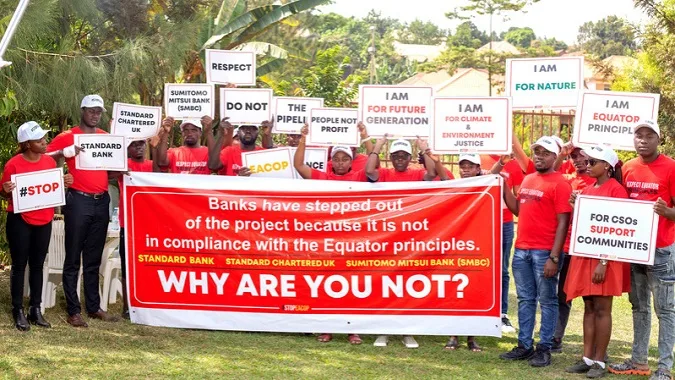
Environmental activists have decried the EACOP project since it poses a great risk to lakes and wetlands in or near its path. Moreover, the project also goes against the drive to phase out fossil fuels and the global trend towards #GreenTransition.
Furthermore, the project is believed to go against the Equator Principles and good #ESG. Therefore, amidst rising protests in Africa and Europe, the consortium of banks consisting of Standard Bank, Standard Chartered Bank and Sumitomo Mitsui Bank backed out of the project, prompting Uganda to look for alternative financiers.